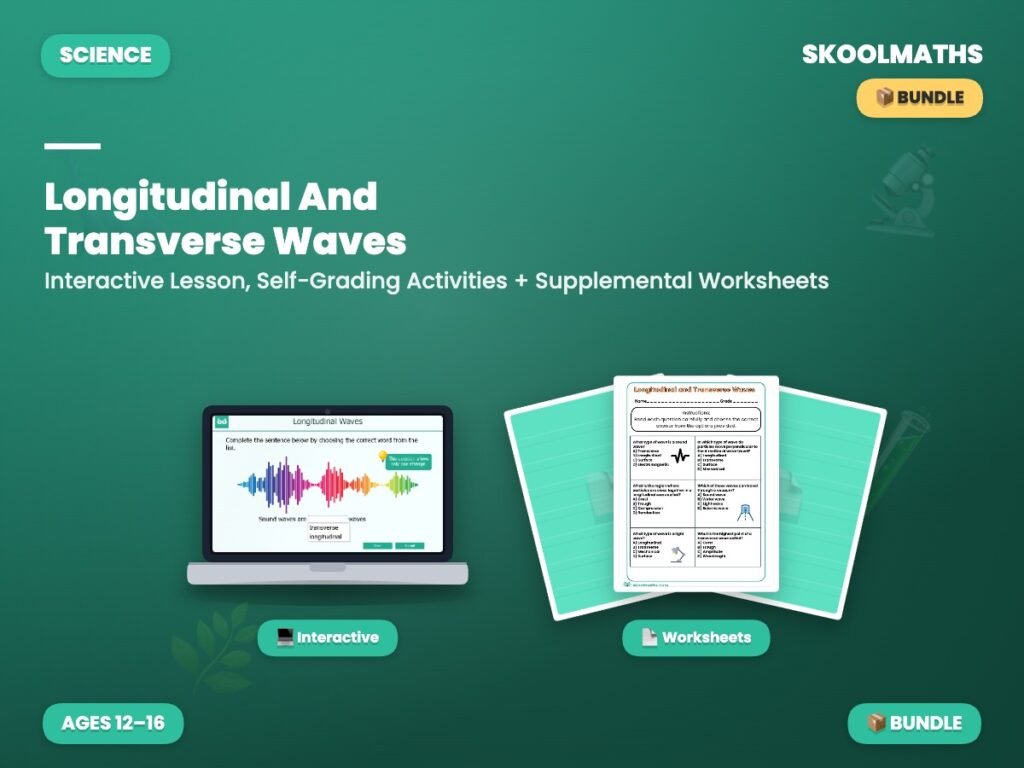
Longitudinal and Transverse Waves

Description
By the end of this unit, students will be able to:
- understand longitudinal and transverse waves;
- learn how these waves are produced.
National Curriculum Objectives
Year 5 Science: Properties and changes of materials
- demonstrate that dissolving, mixing and changes of state are reversible changes
- explain that some changes result in the formation of new materials, and that this kind of change is not usually reversible, including changes associated with burning and the action of acid on bicarbonate of soda
Target Ages
- Age: 9-11
- England & Wales: Year 5-6
- Scotland: Primary 5-6
- Rep. Ireland: Fourth-Fifth Class
- Australia: Grade 4-5
- USA: Grade 4-5
What's Included
- Three-part Lesson
- Self-marking Activities
- Fluency, Reasoning and Problem-solving Questions.
- Engaging Drag and Drop Activities
- Interactive Self-marking Worksheet
- Printable Worksheets to Consolidate Learning
Connected Resources
Trusted by Educators and Loved by Students Worldwide


Choose Your Plan
Maths and Science
Monthly
- Access to all subjects
- Downloadable resources
- Progress tracking for one user
Maths
Monthly
- Access to all Maths Content
- Downloadable resources
- Progress tracking for one user
Science
Monthly
- Access to all Science Content
- Downloadable resources
- Progress tracking for one user
Maths and Science
Monthly
- Access for multiple users
- Access to all subjects
- Downloadable resources
- Progress tracking for all users
Maths
Monthly
- Access for multiple users
- Access to all Maths Content
- Downloadable resources
- Progress tracking for all users
Science
Monthly
- Access for multiple users
- Access to all Science Content
- Downloadable resources
- Progress tracking for all users
In the UK, waves are typically introduced in Key Stage 3, which is the first stage of secondary education for students aged 11-14 years old. Specifically, students are usually taught about waves in Year 8 or Year 9. (US teach at 6th to 7th grade middle school)
During this time, students will learn about the properties and characteristics of different types of waves, including sound waves, light waves, and electromagnetic waves. They will also be introduced to the concept of wave motion, such as amplitude, frequency, and wavelength, and how these properties affect the behaviour of waves.
Students will be taught about the different uses of waves in everyday life, such as in communication and medical imaging. They will also learn about the importance of waves in explaining natural phenomena, such as the behaviour of earthquakes and ocean waves.
By the end of Key Stage 3, students are expected to have a good understanding of waves and their properties, and to be able to use this knowledge to explain a range of physical phenomena.
It’s worth noting that some schools may choose to introduce waves earlier or later than Key Stage 3, depending on their individual curriculum and teaching approach.
Objectives:
- By the end of the lesson, students will be able to define what is meant by a wave and identify the different types of waves.
- Students will be able to describe the properties of waves, including amplitude, wavelength, and frequency.
- By the end of the lesson, students will be able to explain the concept of wave motion and how it applies to different types of waves.
- Students will be able to identify the uses of waves in everyday life, such as in communication and medical imaging.
- By the end of the lesson, students will be able to describe the behaviour of waves, including reflection, refraction, and diffraction.
- Students will be able to explain the relationship between the speed, wavelength, and frequency of a wave.
- By the end of the lesson, students will be able to describe the different types of electromagnetic waves and their uses.
- Students will be able to apply their understanding of waves to explain natural phenomena, such as the behaviour of earthquakes and ocean waves.
- By the end of the lesson, students will be able to design experiments to investigate the properties and behaviour of waves.
- Students will be able to communicate their understanding of waves and their properties in writing and orally.