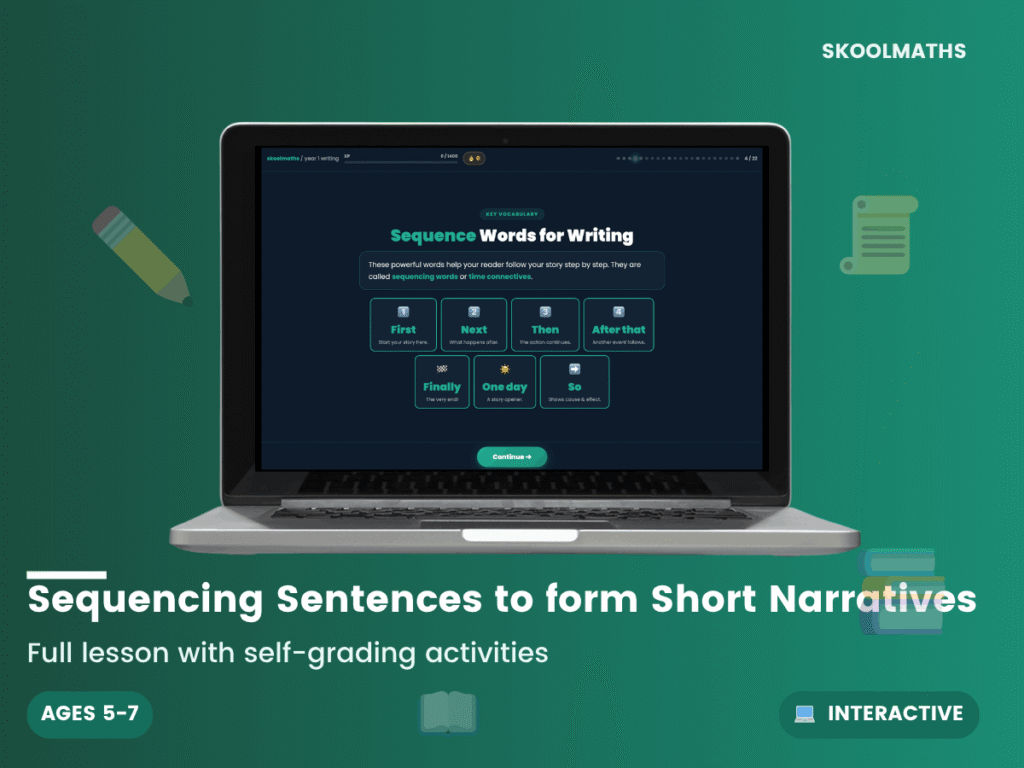
Master the art of storytelling with Sequencing Sentences to Form Short Narratives KS1. This "no-prep" interactive digital lesson helps Year 1 and 2 students organize ideas chronologically to create clear, logical stories and instructional texts.
One-time purchase. Instant digital download.
Turn Jumbled Sentences into Engaging Stories! For early writers, the biggest challenge isn’t just writing a sentence—it’s knowing what comes next. Our Sequencing Sentences to Form Short Narratives KS1 toolkit provides the logical framework young learners need to organize their thoughts. By focusing on the beginning, middle, and end, this resource helps students understand that the order of events is what makes a story make sense.
In Key Stage 1, the National Curriculum emphasizes the ability to “write narratives about personal experiences and those of others.” This Interactive Storytelling Lesson uses visual storyboards and “drag-and-drop” sentence strips to teach children how to identify chronological order. Students will learn to look for time-connective clues to help them succeed at sequencing sentences to form short narratives.
40+ Interactive Slides: Engaging digital lessons featuring “The Jumbled Tale” challenges where students fix broken stories.
Time Connective Focus: Dedicated modules teaching the use of First, Next, Then, After that, and Finally.
Visual Story Mapping: Activities that link illustrations to text, helping students visualize the narrative arc.
Differentiated Worksheets: Three levels of printable tasks, from simple 3-step sequences to complex 6-step narrative building.
Creative Writing Prompts: “Finish the Sequence” tasks that encourage students to write their own logical endings to short stories.
Builds Logical Thinking: Helps children understand cause and effect and the importance of chronological flow.
Improves Reading Comprehension: Better sequencing skills directly translate to a better understanding of the books they read.
Boosts Writing Independence: Gives students a “map” to follow, reducing the “I don’t know what to write” frustration.
KS1 Curriculum Aligned: Precisely mapped to the Year 1 and Year 2 English National Curriculum for Writing (Composition).
Zero Prep Time: A complete “plug-and-play” lesson—perfect for a main literacy session or a small-group guided writing activity.
Visual & Support-Heavy: High-contrast layouts and clear icons make this ideal for supporting SEN and EAL learners.
| Year Group | Year 2 English |
|---|---|
| Resource Type | 🎓 Interactive Lesson & Activities |
| Format | Digital Only |
| Curriculum | England & Wales — KS1 (Years 1–2) |
| Added | 5 April 2026 |
Membership unlocks this resource plus every lesson, worksheet and activity — all subjects, all year groups, all in one place.