One-time purchase. Instant digital download.
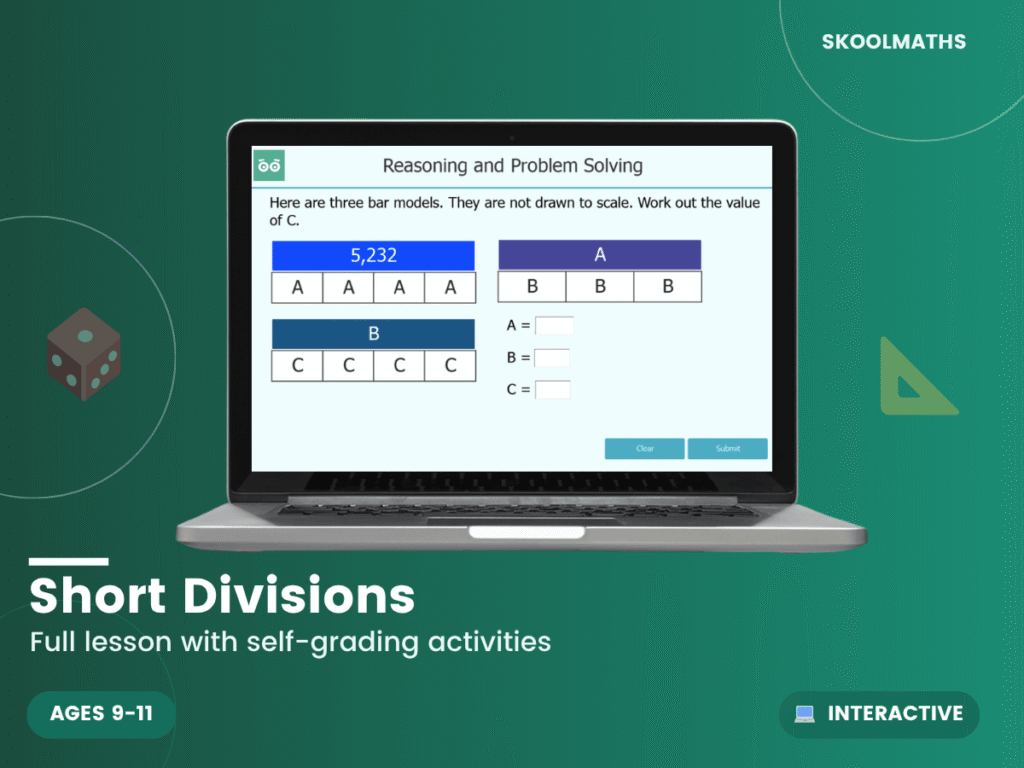
Does 6,180 ÷ 6 leave a remainder? This 29-slide interactive lesson builds fluency with and without remainders.
Pupils learn to divide up to 4-digit numbers by a single digit without a remainder, divide with a remainder, and understand and use place value with the short division method. Worked examples include 675 ÷ 5 and 848 ÷ 4 without a remainder, then larger numbers such as 6,180 ÷ 6 and 3,591 ÷ 7, some of which leave a remainder. Pupils fill in the missing digits at each stage of the method, then solve full problems independently, writing the quotient for calculations such as 1,393 ÷ 7.
A dependable addition to a Year 5–6 number topic, giving pupils a secure, repeatable method for short division. Fluent short division is essential for fractions, ratio and problem solving at the end of KS2.
Build confident division skills today — Add to Basket.
What year group is this for?
Years 5–6 (ages 9–11), KS2.
Does it cover remainders?
Yes — both with and without a remainder.
Is it self-marking?
Yes, with instant feedback on the questions.
| Year Groups | Year 5–6 |
|---|---|
| Resource Type | 🎓 Interactive Lesson & Activities |
| Format | Digital Only |
| Curriculum | England & Wales — KS2 (Years 5–6) |
| Added | 4 March 2026 |
Membership unlocks this resource plus every lesson, worksheet and activity — all subjects, all year groups, all in one place.

Reviews
There are no reviews yet.