Skip to content

Cumulative Frequency — Interactive Lesson (Ages 14–16)

☆☆☆☆☆ Add your review • Year 10–11 • 🎓 Interactive Lesson & Activities
A 19-slide interactive KS4 lesson on cumulative frequency: completing tables, drawing cumulative frequency graphs and estimating the median.

Included in every Skoolmaths plan

  • This resource plus every lesson, worksheet and game in its year group
  • Interactive lessons that mark answers and read aloud
  • New resources added every month
⭐ Get every resource with a Skoolmaths plan

or buy just this resource for $4.57

✅ Instant Access
💻 Any Device
🔒 Secure Checkout
♻️ Use Anytime

Lesson at a glance

What pupils will learn

  • Complete a cumulative frequency table
  • Plot points at upper class boundaries
  • Estimate median, quartiles and IQR

Curriculum

UK
Year 10–11 Maths, National Curriculum (England)
Topic area
Statistics
US equivalent
Grades 9–10 (year level only; not mapped to US standards)

How it is interactive

  • 10 fill-in-the-blank questions
  • 4 short-answer questions
  • 3 multiple-choice questions
  • 1 true or false question
  • 1 reveal card

Feedback and what you get

Questions are marked automatically as pupils answer: a sound and a character reaction show straight away whether they are right, and correct answers earn points, with a results screen at the end.

A 23-slide interactive lesson that runs in any web browser on a computer, tablet or interactive whiteboard. Members open it online from their year group page. Buying it on its own gives you a .zip download to unzip and open.

Free preview: try the first slides before you decide. Included in every Skoolmaths plan.

Do your students plot the wrong values on a cumulative frequency graph? This 19-slide interactive lesson teaches cumulative frequency from the table to the curve.

Mastering Cumulative Frequency at GCSE

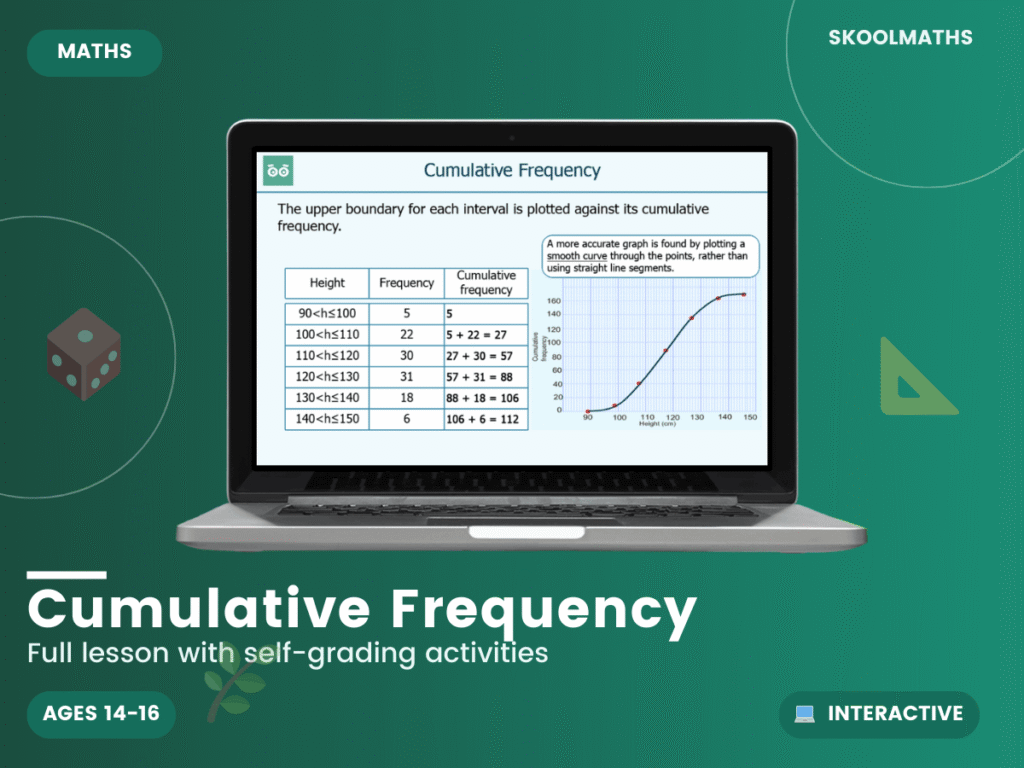
Students learn to calculate and complete a cumulative frequency table by adding each frequency to the running total, checking that the final value equals the total frequency. They then construct the graph by plotting the upper boundary of each class interval against its cumulative frequency, joining the points with a smooth curve, and use the graph to find an estimate of the median. Worked examples use data such as students’ heights and hours worked.

What’s Included

  • 19-slide interactive lesson on cumulative frequency
  • Learning objectives: complete the table, construct and interpret the graph, estimate the median
  • Worked examples with class intervals such as 100 < h ≤ 110
  • Step-by-step running totals with a built-in check
  • Self-marking questions with instant feedback

Key Benefits for Students

  • Makes running totals and upper boundaries clear
  • Shows why a smooth curve gives a more accurate graph
  • Links the graph to estimating the median
  • Instant feedback on answer questions

Why Teachers Love It

  • No prep — ready for whole-class teaching on an interactive whiteboard
  • Worked examples model each stage of the method
  • Self-marking questions support independent practice
  • Suits teaching, revision and homework
  • A useful lesson to return to before statistics exams

Love this? You’ll love…

A dependable addition to a GCSE statistics topic, giving students a clear method for a graph type that often costs marks. Confidence here also supports work on box plots and comparing distributions.

Build confident statistics skills today — Add to Basket.

FAQ

What year group is this for? Years 10–11 (ages 14–16), GCSE.

Does it cover estimating the median? Yes — students use the graph to estimate the median.

Is it self-marking? Yes, with instant feedback on the questions.

Year Groups Year 10–11
Resource Type 🎓 Interactive Lesson & Activities
Format Digital Only
Curriculum England & Wales — KS4 (Years 10–11)
Added 4 March 2026

Reviews

There are no reviews yet.

Add your review

Your email address will not be published. Required fields are marked *

🎓 Get every resource for one low price

Membership unlocks this resource plus every lesson, worksheet and activity — all subjects, all year groups, all in one place.
View Membership Plans →

Free: our First Two Weeks Starter Pack

Eight print-and-go pages for a calm start with a new class, plus new lessons as we add them. About two emails a month.