Skip to content

Measuring Mass with Non-Standard Units — Interactive Lesson (Ages 5–6)

☆☆☆☆☆ Add your review • Year 1 Maths • 🎓 Interactive Lesson & Activities
A 16-slide interactive Year 1 lesson on measuring mass using non-standard units such as cubes, and understanding what a balanced scale means.

Included in every Skoolmaths plan

  • This resource plus every lesson, worksheet and game in its year group
  • Interactive lessons that mark answers and read aloud
  • New resources added every month
⭐ Get every resource with a Skoolmaths plan

or buy just this resource for $4.44

✅ Instant Access
💻 Any Device
🔒 Secure Checkout
♻️ Use Anytime

Lesson at a glance

What pupils will learn

  • use non-standard units, such as cubes or wooden bricks, to measure the mass of an object;
  • understand that a balanced scale means that the objects have the same mass.

Curriculum

UK
Year 1 Maths, National Curriculum (England)
Topic area
Measurements
US equivalent
Kindergarten (year level only; not mapped to US standards)

How it is interactive

  • 11 fill-in-the-blank questions
  • 2 multiple-choice questions

Feedback and what you get

Questions are marked automatically as pupils answer: a sound and a character reaction show straight away whether they are right, and correct answers earn points, with a results screen at the end.

A 16-slide interactive lesson that runs in any web browser on a computer, tablet or interactive whiteboard. Members open it online from their year group page. Buying it on its own gives you a .zip download to unzip and open.

Free preview: try the first slides before you decide. Included in every Skoolmaths plan.

How many cubes does the apple weigh? This 16-slide interactive lesson introduces measuring mass with cubes and balance scales.

Learning Measuring Mass in Year 1 Maths

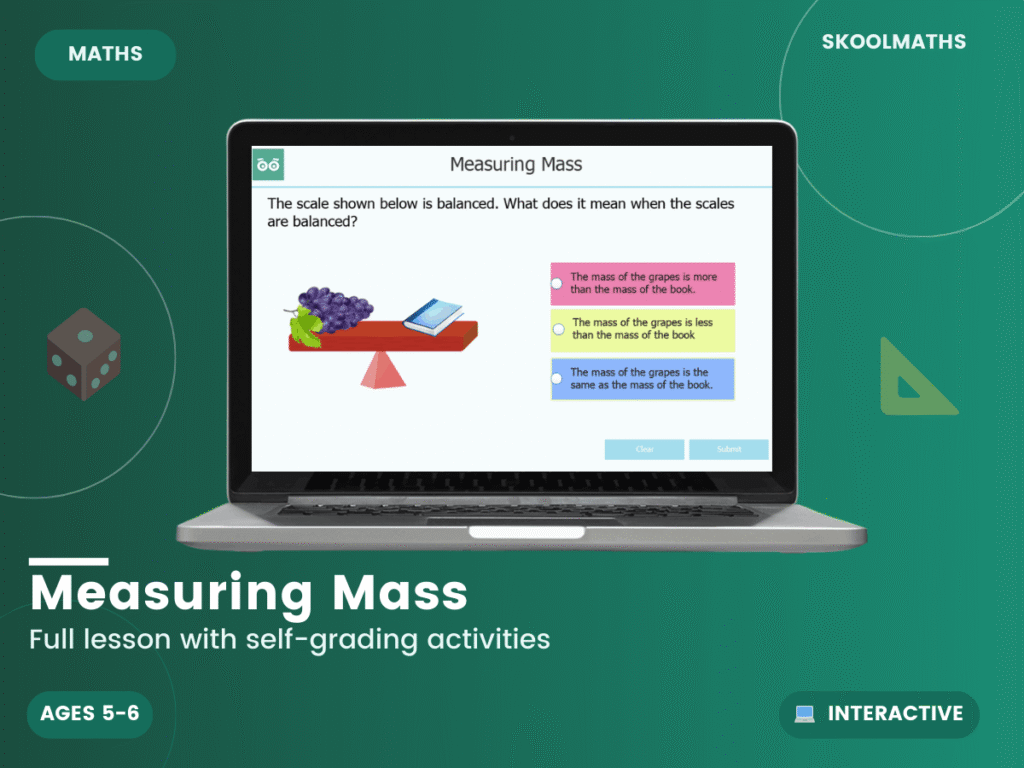
Children learn to use non-standard units, such as cubes or wooden bricks, to measure the mass of an object, and to understand that a balanced scale means the objects have the same mass. They decide what it means when a scale is balanced, find the mass of an aubergine, a cake and a fruit bowl in cubes, and place cubes on a scale to balance a muffin of 6 cubes, a mug of 5 cubes or an ice cream of 3 cubes.

What’s Included

  • 16-slide interactive lesson on measuring mass
  • Learning objectives on non-standard units and balanced scales
  • Questions reading the mass of everyday objects in cubes
  • Drag-and-drop activities balancing a scale with cubes
  • A reasoning and problem-solving question with instant feedback

Key Benefits for Students

  • Builds a concrete idea of mass and comparison
  • Shows what a balanced scale means
  • Uses familiar objects such as fruit, cake and books
  • Instant feedback on answer questions

Why Teachers Love It

  • No prep — ready for whole-class teaching on an interactive whiteboard
  • Pairs naturally with real balance scales and cubes
  • Self-marking questions support independent practice
  • Suits small groups and whole-class sessions
  • A concise lesson that fits a single session

Love this? You’ll love…

A dependable addition to a Year 1 measures topic, giving children a hands-on way into measuring mass. Comparing and measuring with non-standard units prepares them for grams and kilograms later.

Make measuring mass simple — Add to Basket.

FAQ

What year group is this for? Year 1 (ages 5–6).

Does it use standard units? No — it uses non-standard units such as cubes.

Is it self-marking? Yes, with instant feedback on the questions.

Year Group Year 1 Maths
Resource Type 🎓 Interactive Lesson & Activities
Format Digital Only
Curriculum England & Wales — KS1 (Year 1)
Added 22 April 2019

Reviews

There are no reviews yet.

Add your review

Your email address will not be published. Required fields are marked *

🎓 Get every resource for one low price

Membership unlocks this resource plus every lesson, worksheet and activity — all subjects, all year groups, all in one place.
View Membership Plans →

Free: our First Two Weeks Starter Pack

Eight print-and-go pages for a calm start with a new class, plus new lessons as we add them. About two emails a month.