
Included in every Skoolmaths plan
Questions are marked automatically as pupils answer: a sound and a character reaction show straight away whether they are right, and correct answers earn points, with a results screen at the end.
A 19-slide interactive lesson that runs in any web browser on a computer, tablet or interactive whiteboard. Members open it online from their year group page. Buying it on its own gives you a .zip download to unzip and open.
Free preview: try the first slides before you decide. Included in every Skoolmaths plan.
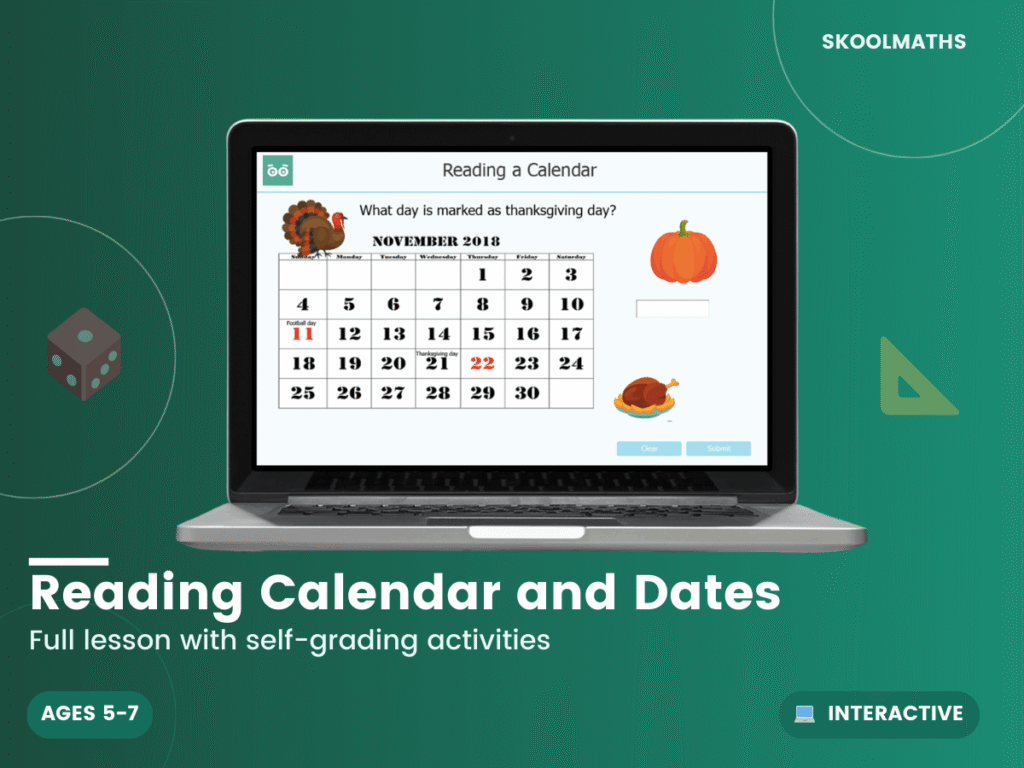
“What day is it tomorrow?” is a question every KS1 pupil needs to be able to answer for themselves. This interactive lesson turns reading a calendar from an abstract concept into a hands-on skill, with instant self-marking feedback at every step.
Pupils practise reading a calendar to identify days, months and dates, then apply that knowledge to solve simple real-world calendar problems.
Reading a calendar draws together sequencing, number order and real-world reasoning. This resource covers the KS1 National Curriculum requirement to compare and sequence intervals of time, including days, weeks and months, practised in a genuinely everyday context.
Is this aligned to the National Curriculum? Yes — it covers the KS1 statutory requirement for telling and comparing time, including days, weeks and months.
What year groups is it for? Currently categorised for Year 1 and Year 2 (KS1).
| Year Groups | Year 1–2 |
|---|---|
| Resource Type | 📋 Lesson Pack |
| Format | Print & Digital |
| Curriculum | England & Wales — KS1 (Years 1–2) |
| Added | 22 April 2019 |
Membership unlocks this resource plus every lesson, worksheet and activity — all subjects, all year groups, all in one place.
Free: our First Two Weeks Starter Pack
Eight print-and-go pages for a calm start with a new class, plus new lessons as we add them. About two emails a month.
Reviews
There are no reviews yet.