One-time purchase. Instant digital download.
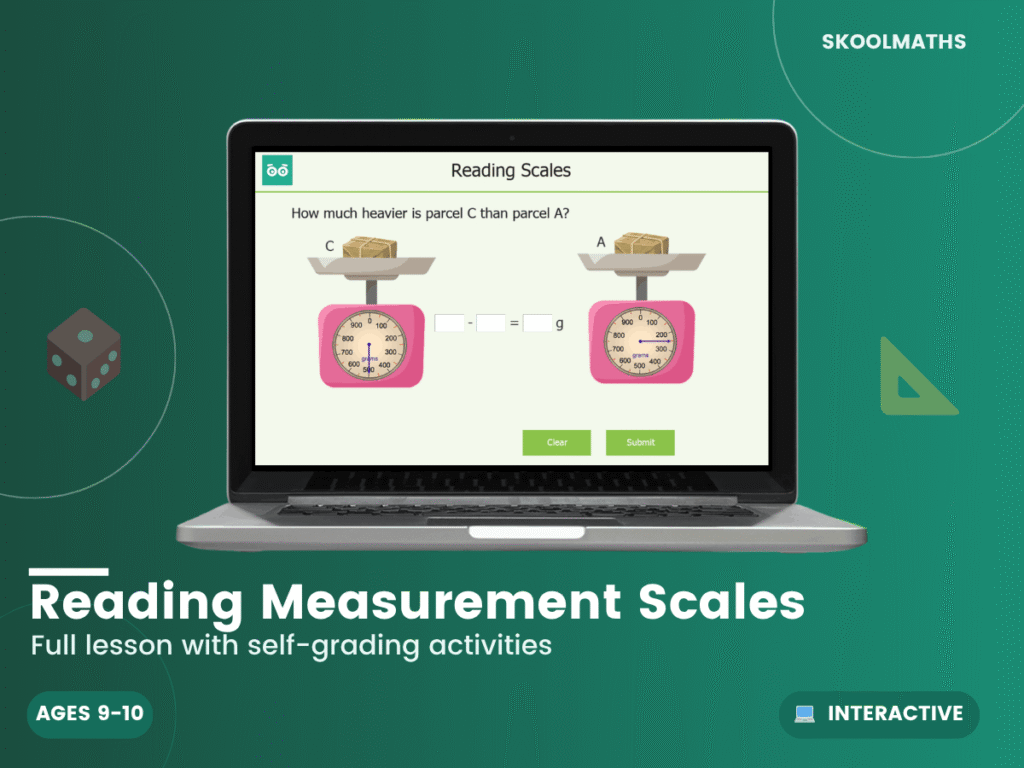
What does each mark on a scale actually represent? This 36-slide interactive lesson teaches reading measurement scales across mass, capacity and temperature.
Pupils learn to read and understand scales on a range of measuring instruments, and to convert between grams and kilograms. They start by working out what each mark or division on a scale represents, for example steps of 5 grams, then read the mass of oranges, a cake or a bag of sugar, the volume of liquid in a jug, and the temperature on a thermometer. Later questions compare the weight of several parcels, find the weight of one egg from a scale showing six, and calculate a difference in weight between two readings.
A dependable addition to a Year 5 measurement topic, giving pupils a transferable method for reading any scale accurately. This skill applies directly to science investigations as well as maths.
Build confident scale-reading skills today — Add to Basket.
What year group is this for?
Year 5 (ages 9–10), KS2.
Does it cover temperature as well as mass?
Yes — mass, capacity and temperature scales are all included.
Is it self-marking?
Yes, with instant feedback on the questions.
| Year Group | Year 5 Maths |
|---|---|
| Resource Type | 🎓 Interactive Lesson & Activities |
| Format | Digital Only |
| Curriculum | England & Wales — KS2 (Year 5) |
| Added | 22 April 2019 |
Verified reviews left by teachers who bought this resource on our TES and Teachers Pay Teachers stores.
This was a great interactive activity to help my students understand this skill.
Membership unlocks this resource plus every lesson, worksheet and activity — all subjects, all year groups, all in one place.

Reviews
There are no reviews yet.