This site uses cookies for analytics and to improve your experience. By clicking Accept, you consent to our use of cookies. Learn more in our privacy policy.
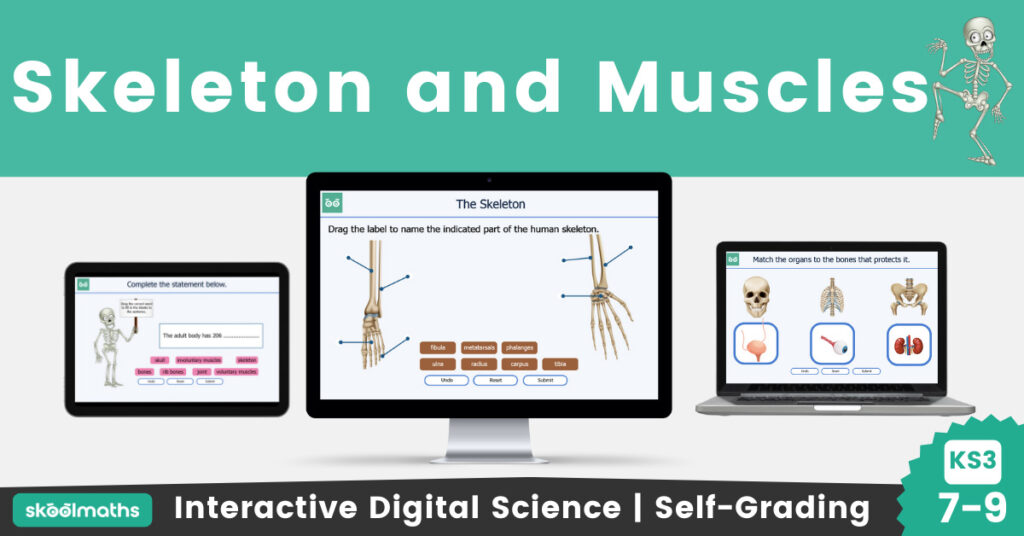
In this fun-packed science lesson, students will learn about the skeleton and muscles. They will find out about the difference between the endoskeleton and exoskeleton. They will also learn what vertebrates and invertebrates are, the function of the muscles, and how it is attached to the bones with tendons.
What learners will learn in this lesson:
understand the functions of the skeleton
to be able to explain various features of the skeleton
relate images of bones, muscles, and joints to diagrams and the body
distinguish between vertebrates and invertebrates
National Curriculum Objectives
KS3 Science: The skeletal and muscular systems
learn about the structure and functions of the human skeleton, to include support, protection, movement and making blood cells
biomechanics – the interaction between skeleton and muscles, including the measurement of force exerted by different muscles
the function of muscles and examples of antagonistic muscles
Target Ages
Age: 9-11
England & Wales: Year 5-6
Scotland: Primary 5-6
Rep. Ireland: Fourth-Fifth Class
Australia: Grade 4-5
USA: Grade 4-5
What’s Included
Three-part Lesson
Self-marking Activities
Fluency, Reasoning and Problem-solving Questions.
Engaging Drag and Drop Activities
Interactive Self-marking Worksheet
Printable Worksheets to Consolidate Learning
In this fun-packed science lesson, students will learn about the skeleton and muscles. They will find out about the difference between the endoskeleton and exoskeleton. They will also learn what vertebrates and invertebrates are, the function of the muscles, and how it is attached to the bones with tendons.
What learners will learn in this lesson:
understand the functions of the skeleton
to be able to explain various features of the skeleton
relate images of bones, muscles, and joints to diagrams and the body
distinguish between vertebrates and invertebrates
KS3 Science: The skeletal and muscular systems
learn about the structure and functions of the human skeleton, to include support, protection, movement and making blood cells
biomechanics – the interaction between skeleton and muscles, including the measurement of force exerted by different muscles
the function of muscles and examples of antagonistic muscles
Age: 9-11
England & Wales: Year 5-6
Scotland: Primary 5-6
Rep. Ireland: Fourth-Fifth Class
Australia: Grade 4-5
USA: Grade 4-5
Three-part Lesson
Self-marking Activities
Fluency, Reasoning and Problem-solving Questions.
Engaging Drag and Drop Activities
Interactive Self-marking Worksheet
Printable Worksheets to Consolidate Learning
Connected Resources
Trusted by Educators and Loved by Students Worldwide
Right for my child, the 4th option we’ve used this year, and my daughter is learning well!
Julia BeckParent
I’ve used Skoolmaths for 6 months. Engaging, easy to use, and perfect for extra practice. My son loves it!
Alexsa RiblerParent
Skoolmaths offers everything for my classrooms, including engaging digital activities and printable worksheets.
Robert FlingHead of Departement
Since subscribing to Skoolmaths, my children have improved greatly with engaging and effective interactive learning materials.
Yvonne BennetParent
I use the resources primarily for students with learning difficulties, and on the autism spectrum for extra practice and during independent centers.
Mrs RisgbyTeacher
OK, I get the point!
Build a strong foundation in number and shape recognition, and develop key skills in maths.
In this fun-packed science lesson, students will learn about the skeleton and muscles. They will find out about the difference between the endoskeleton and exoskeleton. They will also learn what vertebrates and invertebrates are, the function of the muscles, and how it is attached to the bones with tendons.
What learners will learn in this lesson:
understand the functions of the skeleton
to be able to explain various features of the skeleton
relate images of bones, muscles, and joints to diagrams and the body
distinguish between vertebrates and invertebrates
KS3 Science: The skeletal and muscular systems
learn about the structure and functions of the human skeleton, to include support, protection, movement and making blood cells
biomechanics – the interaction between skeleton and muscles, including the measurement of force exerted by different muscles
the function of muscles and examples of antagonistic muscles
Connected Resources
Trusted by Educators and Loved by Students Worldwide
Choose Your Plan
Year Group
Year 9 Biology
Resource Type
📁 Digital Resource
Format
Print & Digital
Curriculum
England & Wales — KS3 (Years 7–9)
Added
4 March 2026
🎓 Get every resource for one low price
Membership unlocks this resource plus every lesson, worksheet and activity — all subjects, all year groups, all in one place.
 Julia BeckParent
I’ve used Skoolmaths for 6 months. Engaging, easy to use, and perfect for extra practice. My son loves it!
Julia BeckParent
I’ve used Skoolmaths for 6 months. Engaging, easy to use, and perfect for extra practice. My son loves it!
 Alexsa RiblerParent
Skoolmaths offers everything for my classrooms, including engaging digital activities and printable worksheets.
Alexsa RiblerParent
Skoolmaths offers everything for my classrooms, including engaging digital activities and printable worksheets.
 Robert FlingHead of Departement
Since subscribing to Skoolmaths, my children have improved greatly with engaging and effective interactive learning materials.
Robert FlingHead of Departement
Since subscribing to Skoolmaths, my children have improved greatly with engaging and effective interactive learning materials.
 Yvonne BennetParent
I use the resources primarily for students with learning difficulties, and on the autism spectrum for extra practice and during independent centers.
Yvonne BennetParent
I use the resources primarily for students with learning difficulties, and on the autism spectrum for extra practice and during independent centers.
 Mrs RisgbyTeacher
OK, I get the point!
Mrs RisgbyTeacher
OK, I get the point!
