One-time purchase. Instant digital download.
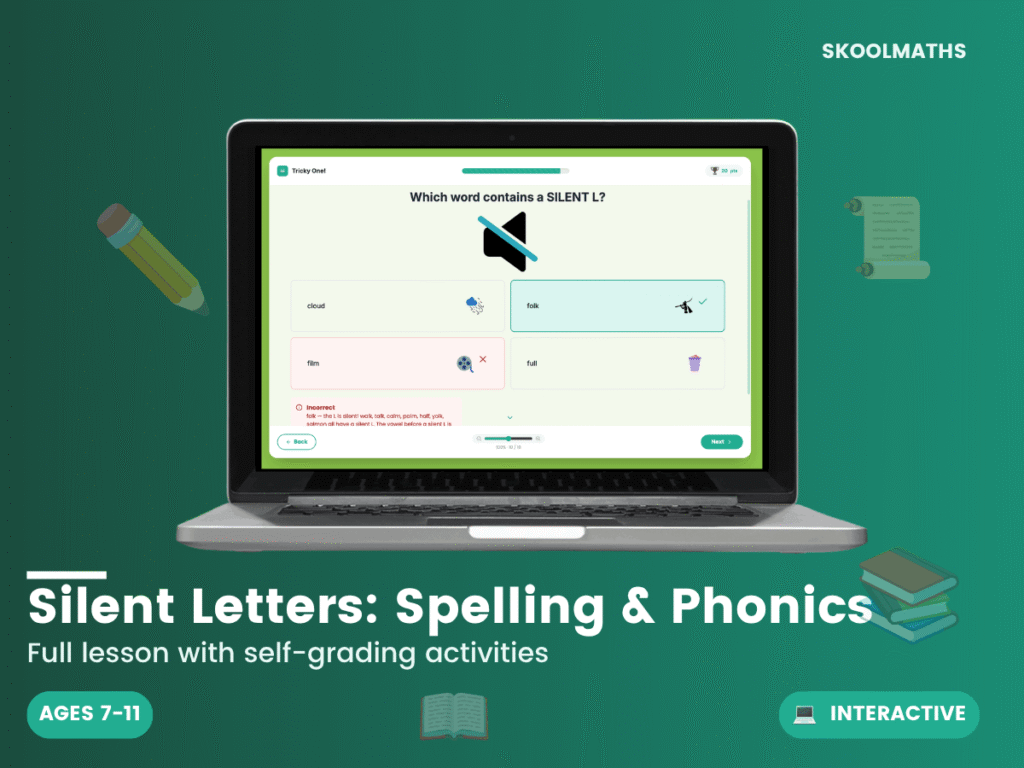
Why is there a k in knight? This 12-slide interactive lesson explores silent letters, showing that each pattern has a real history behind it.
Pupils learn to identify the most common silent letter patterns in English, spell words correctly that contain silent letters, and understand why silent letters exist through etymology. Many silent letters come from Old English, Latin or Greek, once pronounced but left behind as spoken English changed while spelling stayed the same. Pupils learn word groups such as kn- words (knight, kneel, knife, knock, knot, knuckle, knowledge), wr- words (write, wreck, wrap, wrist, wrong, wrestle, wring) and -mb words such as lamb.
A dependable addition to a KS2 spelling topic, giving pupils a pattern-based way to spell some of English’s trickiest words. Understanding the history behind a spelling rule makes it far easier to remember.
Make silent letters make sense — Add to Basket.
What year group is this for?
KS2 — Years 3–6 (ages 7–11).
Which patterns are covered?
kn-, wr- and -mb, among others.
Is it self-marking?
Yes, with instant feedback on the questions.
| Year Groups | Year 3–6 |
|---|---|
| Resource Type | 🎓 Interactive Lesson & Activities |
| Format | Digital Only |
| Curriculum | England & Wales — KS2 (Years 3–6) |
| Added | 10 June 2026 |
Membership unlocks this resource plus every lesson, worksheet and activity — all subjects, all year groups, all in one place.



Reviews
There are no reviews yet.