One-time purchase. Instant digital download.
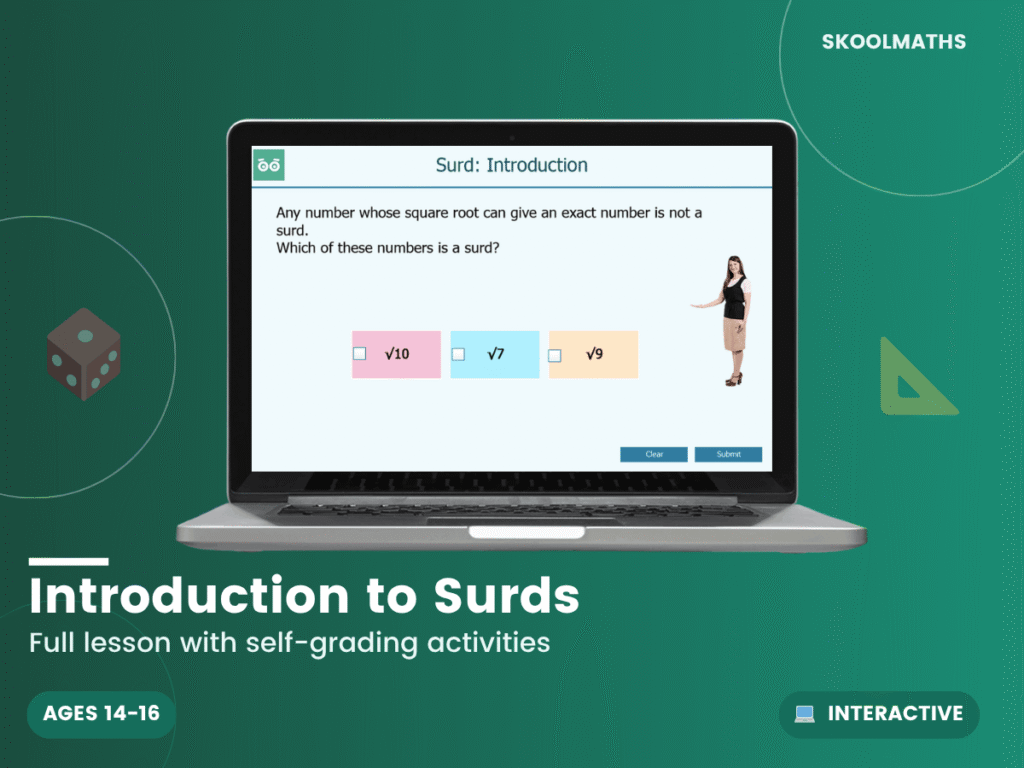
This Introduction to Surds lesson teaches students what a surd actually is, how to recognise one, and why some square roots simplify to whole numbers while others cannot. Across 13 slides, students build the key vocabulary — surd, rational number, irrational number, perfect square and simplest surd form — before applying it to real reasoning questions.
Rather than simply stating definitions, the lesson asks students to explain their thinking: for example, explaining why √20 is a surd but √25 is not, and identifying a number between 40 and 50 whose square root is a surd. A sorting activity then checks students can apply the distinction confidently across a range of examples.
By the end of the lesson, students will be able to recognise which square roots are surds and explain their reasoning using perfect squares — the essential foundation before moving on to simplifying, adding and multiplying surds at GCSE.
Surds come up repeatedly across GCSE maths, from simplifying expressions to rationalising denominators, so getting this foundational distinction right early makes every later surds topic considerably more straightforward.
The lesson is fully interactive and self-marking, with instant feedback on every question, making it ideal for first teaching or a focused revision session.
| Year Groups | Year 10–11 |
|---|---|
| Resource Type | 🎓 Interactive Lesson & Activities |
| Format | Digital Only |
| Curriculum | England & Wales — KS4 (Years 10–11) |
| Added | 4 March 2026 |
Membership unlocks this resource plus every lesson, worksheet and activity — all subjects, all year groups, all in one place.

Reviews
There are no reviews yet.