One-time purchase. Instant digital download.
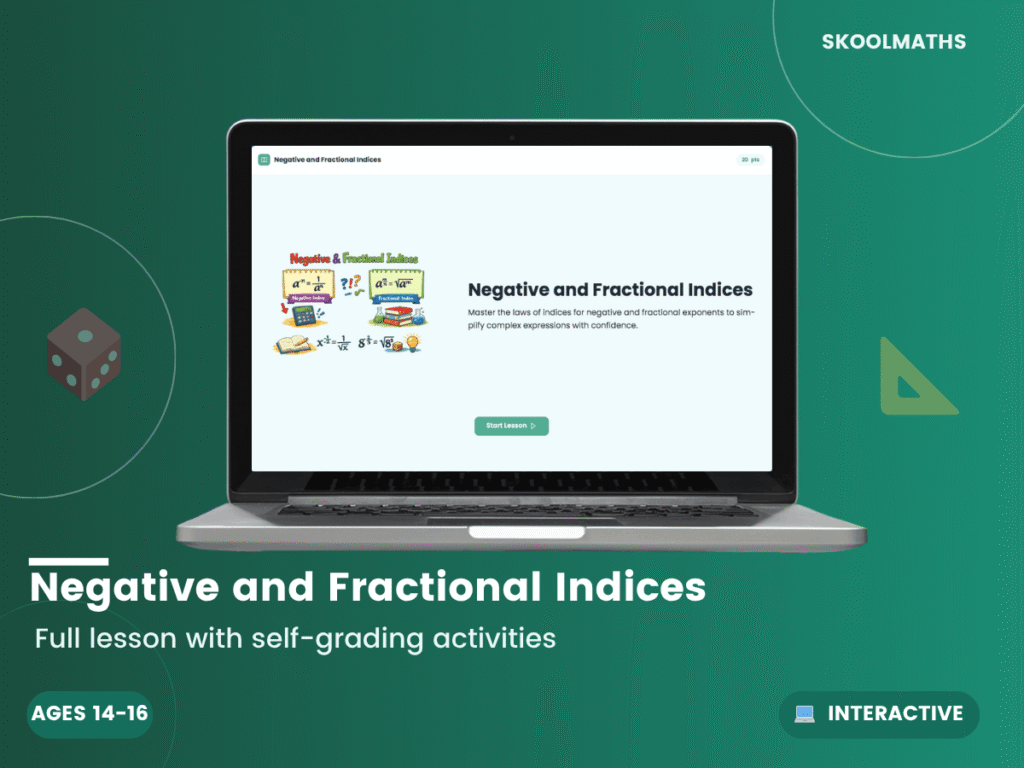
What is 8−2/3? This 31-slide interactive lesson teaches negative and fractional indices, building up from the core index laws.
Students recall the laws of indices for multiplying, dividing and raising a power to a power, then learn that a negative index means the reciprocal, so 2⁻³ = 1/8, and that a fractional index means a root, so 8^(1/3) = 2. They combine both rules, for example 27^(2/3) = 9 and 8^(−2/3) = 1/4, work with fractional bases such as (2/3)⁻² = 9/4 and finish with exam-style questions that combine several laws.
A dependable addition to a GCSE number and algebra topic, giving students a clear set of rules for a topic that often costs marks. Confident use of indices supports surds, standard form and algebraic manipulation.
Build confident number skills today — Add to Basket.
What year group is this for? Years 10–11 (ages 14–16), GCSE.
Does it recap the basic index laws? Yes — before moving on to negative and fractional indices.
Is it self-marking? Yes, with instant feedback on the questions.
| Year Groups | Year 10–11 |
|---|---|
| Resource Type | 📋 Lesson Pack |
| Format | Print & Digital |
| Curriculum | England & Wales — KS4 (Years 10–11) |
| Added | 1 May 2019 |
Membership unlocks this resource plus every lesson, worksheet and activity — all subjects, all year groups, all in one place.




Reviews
There are no reviews yet.