One-time purchase. Instant digital download.
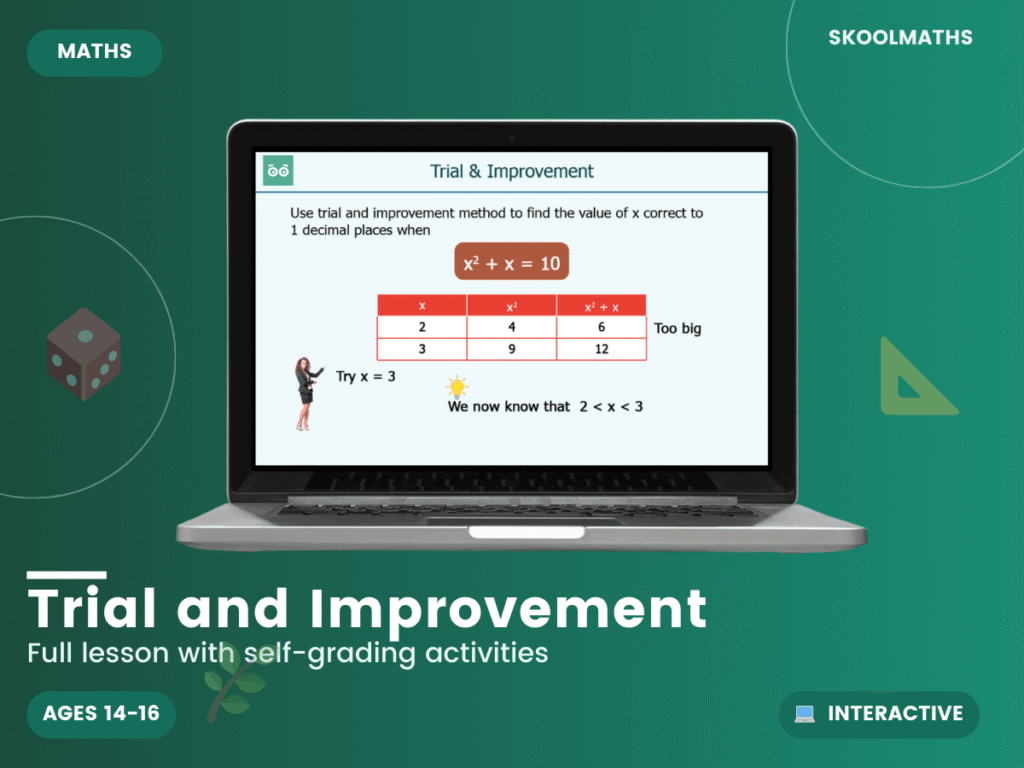
How do you solve an equation with no exact answer? This 34-slide interactive lesson teaches trial and improvement, a systematic way to home in on a solution.
Students learn to solve equations that have no exact value by trial and improvement: substitute a value, decide whether the result is too big or too small, and improve the next guess. A worked example solves x² + x = 10, trying x = 2, 3, then 2.7 and 2.8 to find x correct to 1 decimal place. Students then find solutions to 2 decimal places for equations such as x² + x = 14, x² + 5x = 30 and y³ + 2y = 170.
A dependable addition to a GCSE algebra topic, giving students a clear layout to use whenever an equation cannot be solved exactly. A tidy table of trials is what earns the marks in the exam.
Build confident algebra skills today — Add to Basket.
What year group is this for? Years 10–11 (ages 14–16), GCSE.
Does it cover cubic equations? Yes — for example y³ + 2y = 170.
Is it self-marking? Yes, with instant feedback on the questions.
| Year Groups | Year 10–11 |
|---|---|
| Resource Type | 🎓 Interactive Lesson & Activities |
| Format | Digital Only |
| Curriculum | England & Wales — KS4 (Years 10–11) |
| Added | 22 April 2019 |
Membership unlocks this resource plus every lesson, worksheet and activity — all subjects, all year groups, all in one place.

Reviews
There are no reviews yet.