One-time purchase. Instant digital download.
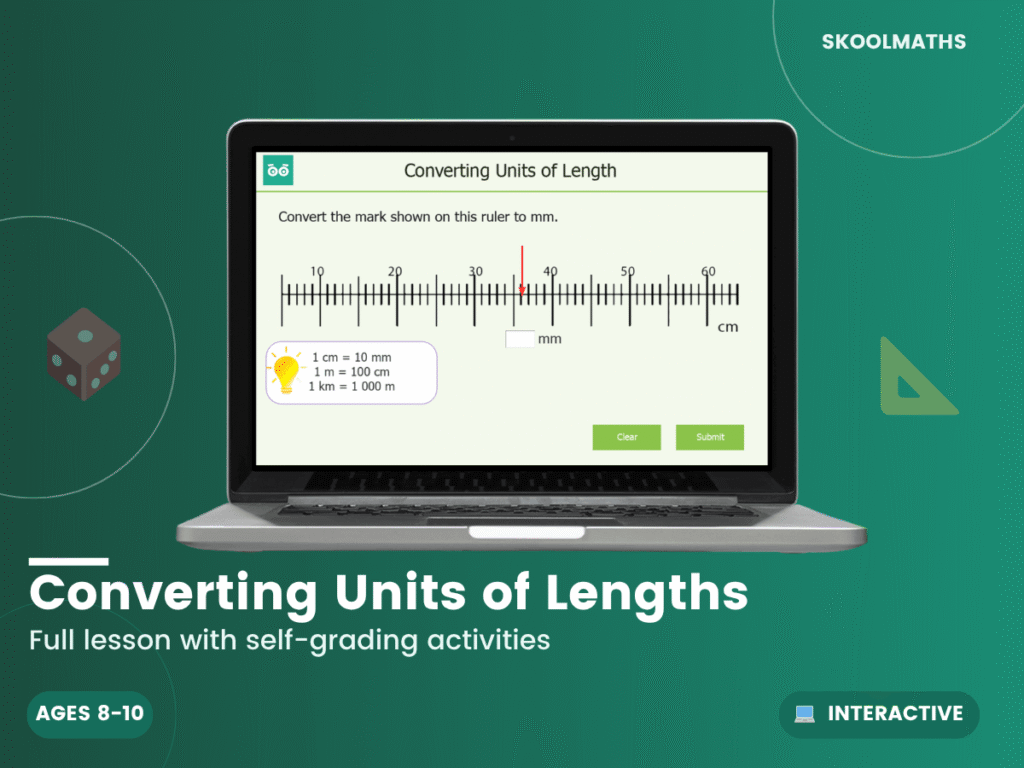
How many kilometres does 2,500 metres make? This 31-slide interactive lesson teaches converting units of length across millimetres, centimetres, metres and kilometres.
Pupils learn to estimate, measure and convert between metric units of length, solving problems involving the calculation and conversion of measurements. They learn the key facts — 1 cm = 10 mm, 1 m = 100 cm, 1 km = 1,000 m — and apply them to read a ruler mark in millimetres, convert 270 mm into metres, and work out how many kilometres a pupil walks to school if the journey is 2,500 metres. A ‘Beat the Clock’ activity gives pupils 60 seconds to multiply and divide by 10, 100 and 1,000, reinforcing the place value behind every conversion.
A dependable addition to a Year 5 measurement topic, giving pupils the fluency to move confidently between millimetres, centimetres, metres and kilometres in any word problem. This skill underpins later work converting units of mass and capacity.
Build confident measuring skills today — Add to Basket.
What year group is this for?
Year 5 (ages 9–10), KS2.
Does it cover all four metric length units?
Yes — millimetres, centimetres, metres and kilometres.
Is it self-marking?
Yes, with instant feedback on the questions.
| Year Group | Year 5 Maths |
|---|---|
| Resource Type | 🎓 Interactive Lesson & Activities |
| Format | Digital Only |
| Curriculum | England & Wales — KS2 (Year 5) |
| Added | 4 March 2026 |
Membership unlocks this resource plus every lesson, worksheet and activity — all subjects, all year groups, all in one place.

Reviews
There are no reviews yet.