One-time purchase. Instant digital download.
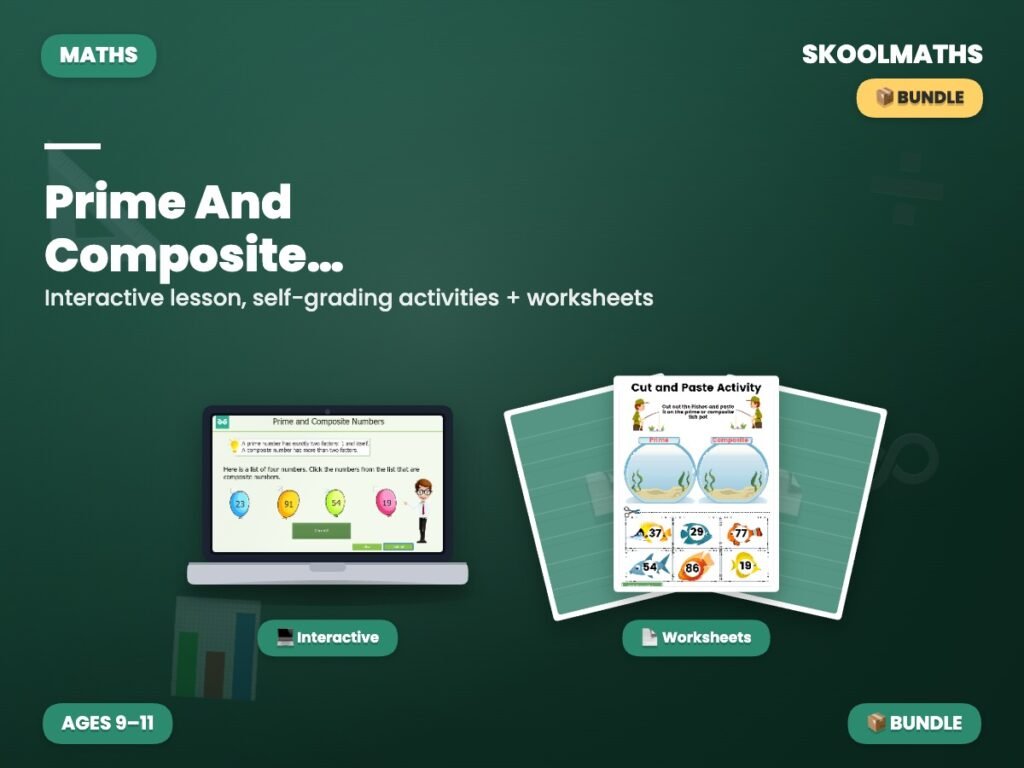
Which fish belong in the prime pot? This 20-slide interactive lesson teaches prime and composite numbers, with a printable cut-and-paste worksheet included.
Pupils learn the difference between prime and composite numbers, build on this to identify prime numbers in a given set, and identify all the prime numbers from 1 to 100. They learn that a prime number has exactly two factors, so 17 is prime because its only factors are 1 and 17, then follow the Sieve of Eratosthenes, crossing out multiples of 2, 3, 5 and 7 from a 1–100 grid to reveal every prime number, with the remaining crossed-out numbers being composite. The worksheet adds a cut-and-paste activity sorting numbers such as 37, 54 and 29 into prime or composite fish pots.
A dependable addition to a Year 5–6 number topic, giving pupils a hands-on way to discover primes for themselves, on screen and on paper. Confident work with primes and composites supports factors, multiples and simplifying fractions.
Build confident number skills today — Add to Basket.
What year group is this for?
Years 5–6 (ages 9–11), KS2.
Is a worksheet included?
Yes — a printable cut-and-paste activity.
Is it self-marking?
Yes, for the interactive lesson questions.
| Subject | Maths |
|---|---|
| Year Groups | Year 5–6 |
| Resource Type | 📋 Lesson Pack |
| Format | Print & Digital |
| Curriculum | England & Wales — KS2 (Years 5–6) |
| Added | 6 September 2022 |
Membership unlocks this resource plus every lesson, worksheet and activity — all subjects, all year groups, all in one place.

Reviews
There are no reviews yet.