One-time purchase. Instant digital download.
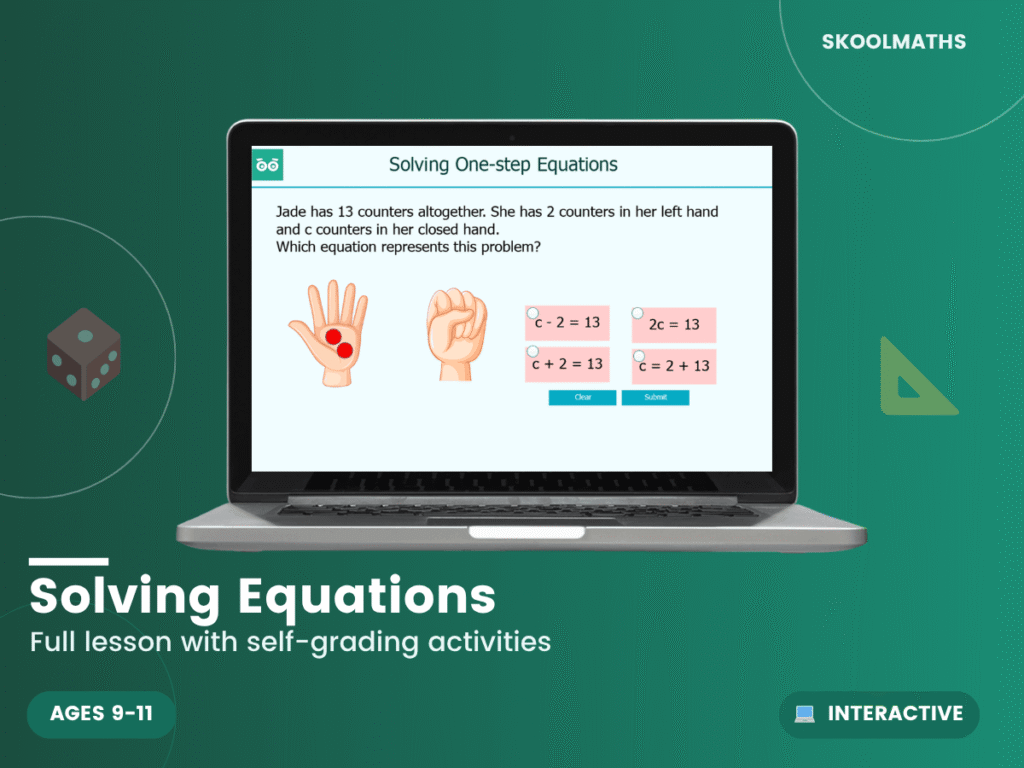
What number can you add to 21 to get 50? This 22-slide interactive lesson teaches solving one-step equations, starting from missing-number problems.
Pupils learn to solve simple one-step equations involving the four operations, and to understand that an equation is a way of solving a missing number problem. They use inverse operations to work out the unknown, moving from a symbol to a letter, so that b + 21 = 50 gives b = 29. Starter activities find missing masses, and problem questions ask them to write an equation for a number puzzle, such as thinking of a number, adding 10 and getting 49.
A dependable addition to a Year 6 algebra topic, giving pupils a gentle first step into equations. Confident missing-number thinking prepares them for algebra in secondary school.
Make first equations friendly — Add to Basket.
What year group is this for? Year 6 (ages 10–11), KS2.
Does it use letters for unknowns? Yes — it moves from a symbol to a letter such as b.
Is it self-marking? Yes, with instant feedback on the questions.
| Year Group | Year 6 Maths |
|---|---|
| Resource Type | 🎓 Interactive Lesson & Activities |
| Format | Digital Only |
| Curriculum | England & Wales — KS2 (Year 6) |
| Added | 22 April 2019 |
Membership unlocks this resource plus every lesson, worksheet and activity — all subjects, all year groups, all in one place.

Reviews
There are no reviews yet.