One-time purchase. Instant digital download.
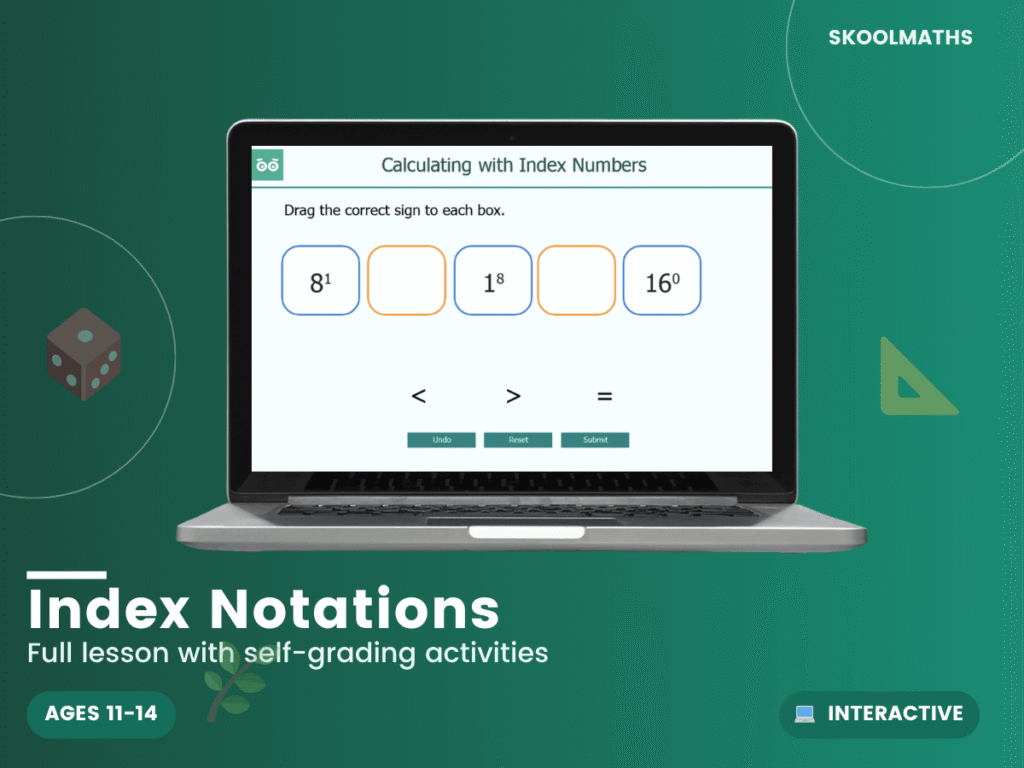
What does 3⁵ actually mean? This 21-slide interactive lesson teaches index notation as a short way to write repeated multiplication.
Students revise the use of index notation, perform simple arithmetic involving indices and compare numbers in index form. They learn the vocabulary of base number and index, power or exponent, and that 3 × 3 × 3 × 3 × 3 is written 3⁵ and read as “3 to the power of 5”, which equals 243. Questions include missing indices, values such as 2³ and 5⁴, calculations such as 3² + 5², and finding m and n when 64 = 8² = 4^m = 2^n.
A dependable addition to a KS3 number and algebra topic, giving students a secure understanding of powers before they learn the laws of indices. Fluent index notation supports standard form, roots and algebra.
Build confident number skills today — Add to Basket.
What year group is this for? KS3 — Years 7–9 (ages 11–14).
Does it cover the laws of indices? No — it focuses on notation, evaluating powers and comparing numbers.
Is it self-marking? Yes, with instant feedback on the questions.
| Year Groups | Year 7–9 |
|---|---|
| Resource Type | 🎓 Interactive Lesson & Activities |
| Format | Digital Only |
| Curriculum | England & Wales — KS3 (Years 7–9) |
| Added | 4 March 2026 |
Membership unlocks this resource plus every lesson, worksheet and activity — all subjects, all year groups, all in one place.


Reviews
There are no reviews yet.