Skip to content

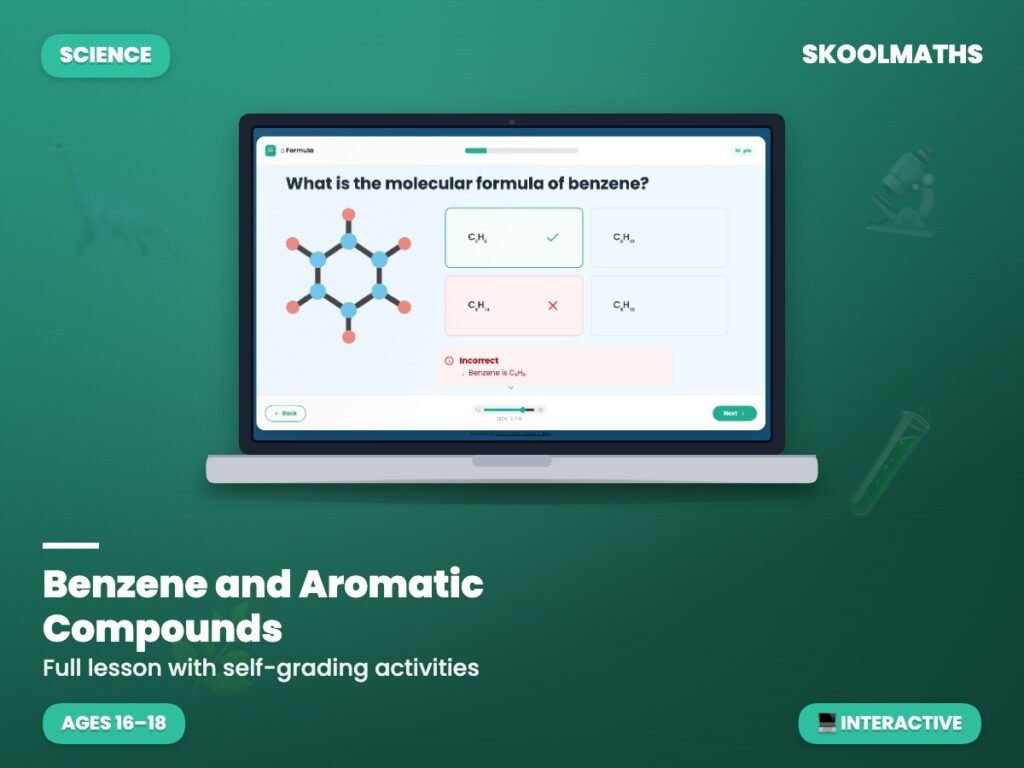
Benzene and Aromatic Compounds — Interactive Lesson (Ages 15–18)

☆☆☆☆☆ Add your review • A-Level Chemistry, Year 10 Science, Year 11 Science, Year 12 Science & Year 13 Science • 🎓 Interactive Lesson & Activities
Pupils describe the flat C₆H₆ ring, compare Kekulé's model with the delocalised model and use bond-length evidence to explain benzene's stability.

Included in every Skoolmaths plan

  • This resource plus every lesson, worksheet and game in its year group
  • Interactive lessons that mark answers and read aloud
  • New resources added every month
⭐ Get every resource with a Skoolmaths plan

or buy just this resource for $4.90

✅ Instant Access
💻 Any Device
🔒 Secure Checkout
♻️ Use Anytime

Lesson at a glance

What pupils will learn

  • Describe the structure of benzene, C₆H₆.
  • Explain what delocalised electrons are.
  • Explain why benzene prefers substitution to addition.
  • Describe how benzene burns.
  • State uses and hazards of aromatic compounds.

Curriculum

UK
Year 10–13 Science (A-level), National Curriculum (England)
Topic area
Organic Chemistry
US equivalent
Grades 9–12 (year level only; not mapped to US standards)

What the lesson covers

  • Benzene: C₆H₆
  • Kekulé and Delocalisation
  • Substitution, Not Addition
  • Burning Benzene
  • Uses and Hazards

How it is interactive

  • 6 multiple-choice questions
  • 2 true or false questions
  • 1 fill-in-the-blank question
  • 1 sorting and ordering task
  • 1 sentence-writing task
  • 1 drag-the-words sentence
  • 1 reveal card

Feedback and what you get

Questions are marked automatically as pupils answer: a sound and a character reaction show straight away whether they are right, and correct answers earn points, with a results screen at the end. Sentence-writing tasks are for pupils' own answers and are not marked automatically.

A 21-slide interactive lesson that runs in any web browser on a computer, tablet or interactive whiteboard. Members open it online from their year group page. Buying it on its own gives you a .zip download to unzip and open.

Free preview: try the first slides before you decide. Included in every Skoolmaths plan.

A ring of six carbons that puzzled chemists for decades. This 21-slide interactive lesson on benzene structure takes pupils from first ideas to exam-style explanations, with 12 self-marking activities and nothing to prepare beforehand.

Teaching Benzene and Aromatic Compounds in GCSE extension and A-level Chemistry

Pupils describe the flat C₆H₆ ring, compare Kekulé’s model with the delocalised model and use bond-length evidence to explain benzene’s stability. They explain why benzene prefers substitution to addition, balance its combustion equation, and learn its industrial uses alongside its hazards as a carcinogen.

What Pupils Will Learn

  • Describe the structure of benzene, C₆H₆.
  • Explain what delocalised electrons are.
  • Explain why benzene prefers substitution to addition.
  • Describe how benzene burns.
  • State uses and hazards of aromatic compounds.

What’s Included

  • 21-slide interactive lesson on benzene structure
  • 12 self-marking activities: multiple-choice questions, true-or-false checks, sorting tasks, drag-and-drop categorising and fill-in-the-gap questions
  • Step-by-step teaching cards that reveal one point at a time
  • A written explanation task with a model answer for self-assessment

Why Teachers Love It

  • No prep — open it on an interactive whiteboard, laptop or tablet
  • Instant feedback explains every answer, right or wrong
  • Examples from both Nigeria and the UK make the chemistry feel real
  • Works for whole-class teaching, independent study or revision

Curriculum Alignment

Supports the organic chemistry content of UK GCSE extension and A-level Chemistry (AQA, Edexcel and OCR) and the Nigerian Senior Secondary Chemistry curriculum (SS2–SS3), including WAEC and NECO exam preparation.

Love this? You’ll love…

Bring benzene structure to life today — Add to Basket.

FAQ

What year groups is this for? Year 11 and post-16 (ages 15–18), and SS2–SS3 in Nigeria.

Is it self-marking? Yes — all 12 activities give instant feedback.

Do pupils need to log in? No. The lesson runs in any modern web browser.

Can I use it for revision? Yes. Pupils can replay it as often as they like, and the results screen shows which questions to review before a test.

Year GroupsA-Level Chemistry, Year 10 Science, Year 11 Science, Year 12 Science & Year 13 Science
Resource Type🎓 Interactive Lesson & Activities
FormatDigital Only
CurriculumEngland & Wales — KS4–Post-16 (Years 10–13)
Added23 October 2026

Reviews

There are no reviews yet.

Add your review

Your email address will not be published. Required fields are marked *

🎓 Get every resource for one low price

Membership unlocks this resource plus every lesson, worksheet and activity — all subjects, all year groups, all in one place.
View Membership Plans →