One-time purchase. Instant digital download.
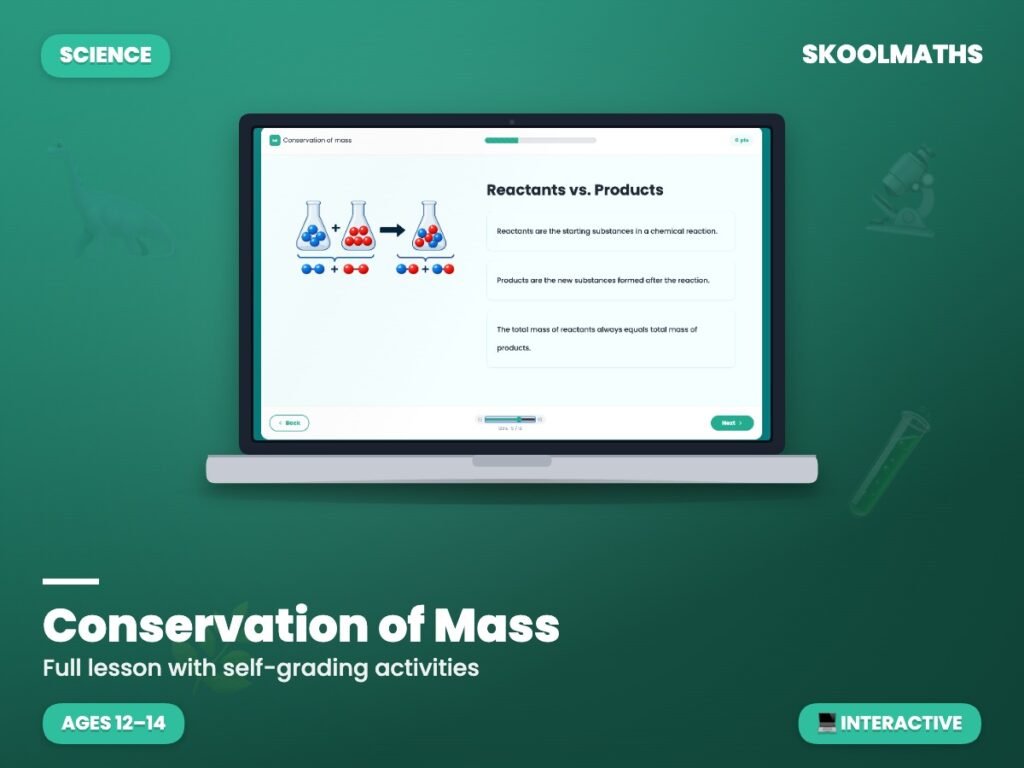
Where does the missing mass go in an open system? This 20-slide interactive lesson explains conservation of mass, a law that can seem to be broken until you understand it properly.
Students learn to explain the law of conservation of mass, understand that mass is conserved in chemical reactions, and practise balancing and analysing chemical equations. They learn that matter cannot be created or destroyed, a law proven by Antoine Lavoisier, so the total mass of reactants always equals the total mass of products. In a closed system mass is clearly conserved, while in an open system gases may escape and make it seem like mass is lost, when it has simply moved out of the system; atoms are only rearranged during a reaction, never gained or lost.
A dependable addition to a KS3 chemistry topic, giving students a clear explanation for a law that regularly confuses learners at first. Understanding conservation of mass here is essential before tackling balancing equations and stoichiometry.
Build confident chemistry skills today — Add to Basket.
What year group is this for?
KS3 — Year 8 (ages 12–13).
Does it explain open versus closed systems?
Yes — including why mass can seem to disappear.
Is it self-marking?
Yes, with instant feedback on the questions.
| Year Groups | Year 8–9 |
|---|---|
| Resource Type | 🎓 Interactive Lesson & Activities |
| Format | Digital Only |
| Curriculum | England & Wales — KS3 (Years 8–9) |
| Added | 24 July 2026 |
Membership unlocks this resource plus every lesson, worksheet and activity — all subjects, all year groups, all in one place.


Reviews
There are no reviews yet.