13 curriculum-aligned number – fractions-decimals-percentages resources for Year 6 Maths — worksheets and digital lessons, or unlock everything with a membership.

Membership unlocks every lesson, worksheet and activity — for every subject and year group.
Year 6 is where fractions, decimals and percentages come together as three ways of writing the same number. This is also where pupils multiply and divide fractions for the first time, ahead of the KS2 SATs.
By the end of Year 6, the National Curriculum expects pupils to:
common factor, common multiple, simplify, equivalent, numerator, denominator, decimal equivalent, percentage
Year 6 draws together the equivalent fractions, mixed numbers and percentages pupils met in Year 5. At secondary school, this fluency underpins algebraic fractions, ratio and proportion.
How do you simplify a fraction?
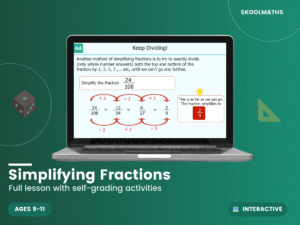
Divide the numerator and denominator by the same common factor until they share no factor other than 1. For example, 8/12 simplifies to 2/3 by dividing both by 4.
How do you multiply two fractions?
Multiply the numerators together and the denominators together, then simplify: 1/4 × 1/2 = (1×1)/(4×2) = 1/8.
Which fraction, decimal and percentage facts are worth memorising?
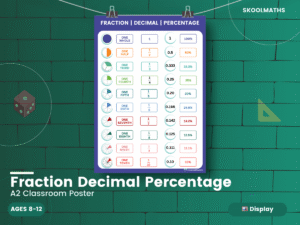
The most useful are 1/2 = 0.5 = 50%, 1/4 = 0.25 = 25%, 3/4 = 0.75 = 75%, and 1/10 = 0.1 = 10%. These come up constantly in SATs-style questions.
Start with our free resources, or get every Year 6 maths lesson with a membership.