Skip to content

Distinguishing Fact and Opinion — Reading Comprehension (KS2)

☆☆☆☆☆ Add your review • Year 3–6 • 🎓 Interactive Lesson & Activities
A 12-slide KS2 reading comprehension lesson distinguishing fact and opinion, spotting the language clues persuasive writers use to blur the line.

Included in every Skoolmaths plan

  • This resource plus every lesson, worksheet and game in its year group
  • Interactive lessons that mark answers and read aloud
  • New resources added every month
⭐ Get every resource with a Skoolmaths plan

or buy just this resource for $3.93

✅ Instant Access
💻 Any Device
🔒 Secure Checkout
♻️ Use Anytime

Lesson at a glance

What pupils will learn

  • Define fact and opinion and explain the difference clearly.
  • Identify linguistic clues that signal opinion in texts.
  • Distinguish fact from opinion in persuasive and non-fiction writing.

Curriculum

UK
Year 3–6 English, National Curriculum (England)
US equivalent
Grades 2–5 (year level only; not mapped to US standards)

What the lesson covers

  • What Is a Fact? ✅
  • What Is an Opinion? 💭
  • Why Writers Blur the Line 🎭

How it is interactive

  • 4 multiple-choice questions
  • 1 sorting and ordering task
  • 1 embedded interactive activity

Feedback and what you get

Questions are marked automatically as pupils answer: a sound and a character reaction show straight away whether they are right, and correct answers earn points, with a results screen at the end.

A 12-slide interactive lesson that runs in any web browser on a computer, tablet or interactive whiteboard. Buying it on its own gives you a .zip download to unzip and open.

Free preview: try the first slides before you decide. Included in every Skoolmaths plan.

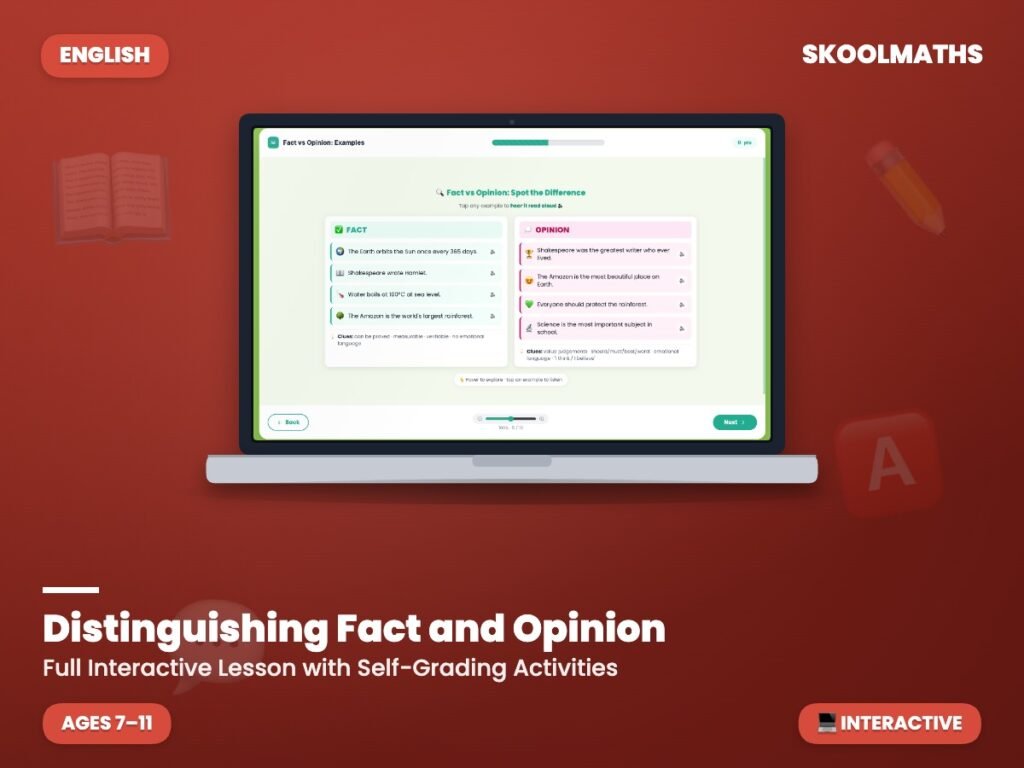
Can you tell when a writer is stating a fact — or just trying to convince you of one? This 12-slide lesson teaches pupils to tell fact and opinion apart, even when persuasive writers try to blur the line.

Fact vs Opinion for KS2 Reading Comprehension

Pupils learn to define fact and opinion, identify the linguistic clues that signal opinion in a text, and distinguish fact from opinion in persuasive and non-fiction writing. A fact can be proved or verified using evidence such as numbers, dates and names, while an opinion is a personal judgement signalled by value words such as ‘best’, ‘worst’ and ‘most’. Pupils examine how persuasive writers sometimes dress opinions up as facts, then sort statements into each category themselves.

What’s Included

  • 12-slide lesson distinguishing fact from opinion
  • Learning objectives on defining fact vs opinion
  • Linguistic clues that signal opinion in a text
  • Examples of persuasive writers presenting opinion as fact
  • A sorting activity classifying statements as fact or opinion

Key Benefits for Students

  • Builds critical reading skills for persuasive texts
  • Teaches the language clues that signal opinion
  • Uses real examples, not just abstract definitions
  • A sorting task to apply the skill independently

Why Teachers Love It

  • No prep — ready for whole-class teaching on an interactive whiteboard
  • A focused lesson that fits a single reading comprehension session
  • Develops critical reading skills needed across the curriculum
  • Suits teaching, revision and homework
  • A dependable addition to a KS2 non-fiction or persuasive writing topic

Love this? You’ll love…

A dependable addition to a KS2 reading comprehension topic, giving pupils the tools to question what they read rather than accept every confident-sounding sentence as true. This critical eye is essential for non-fiction reading and for pupils’ own persuasive writing.

Sharpen critical reading skills today — Add to Basket.

FAQs

What year group is this for?
KS2 — Years 3–6 (ages 7–11).

Does it use real persuasive writing examples?
Yes — including how opinions can be dressed up as facts.

Is it self-marking?
Yes, with instant feedback on the questions.

Year GroupsYear 3–6
Resource Type🎓 Interactive Lesson & Activities
FormatDigital Only
CurriculumEngland & Wales — KS2 (Years 3–6)
Added10 June 2026

Reviews

There are no reviews yet.

Add your review

Your email address will not be published. Required fields are marked *

🎓 Get every resource for one low price

Membership unlocks this resource plus every lesson, worksheet and activity — all subjects, all year groups, all in one place.
View Membership Plans →

Free: our First Two Weeks Starter Pack

Eight print-and-go pages for a calm start with a new class, plus new lessons as we add them. About two emails a month.