One-time purchase. Instant digital download.
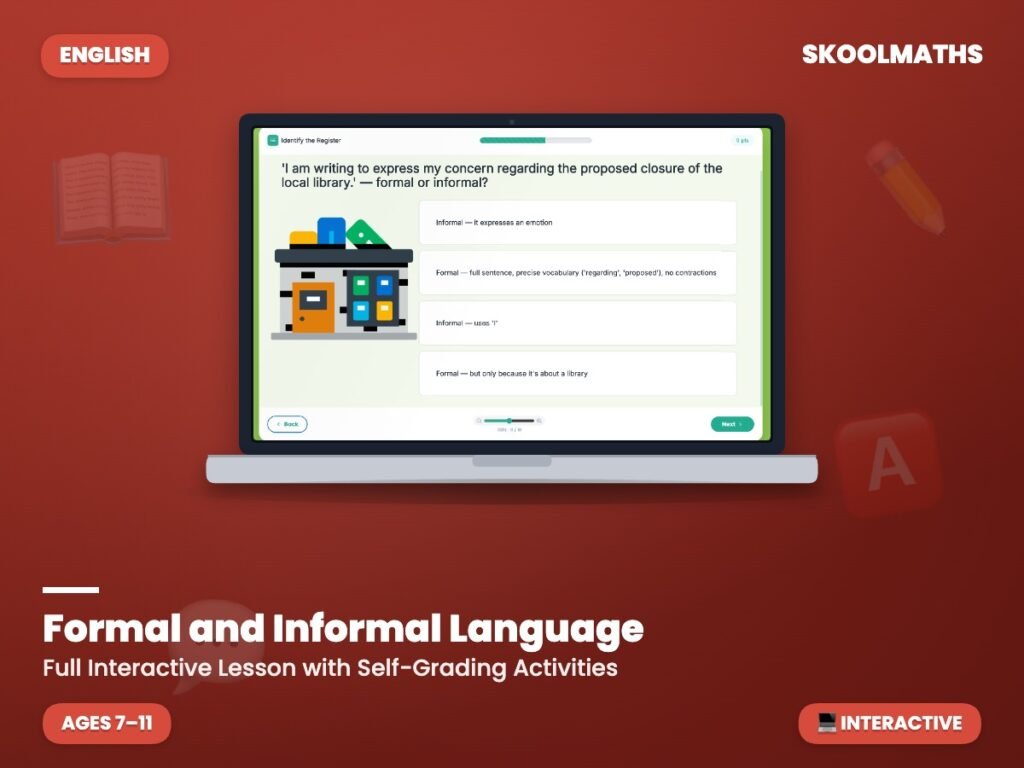
Would you write ‘cannot’ or ‘can’t’ in a letter to the headteacher? This 12-slide interactive lesson teaches formal and informal language by comparing register side by side.
Pupils learn to understand what register means in writing and speaking, identify features of formal and informal language, and choose the appropriate register for their audience and purpose. Formal language uses full sentences, precise vocabulary and an impersonal tone, avoiding contractions such as ‘can’t’ in favour of ‘cannot’, while informal language uses contractions, colloquial expressions such as ‘cool’ and ‘awesome’, and a personal tone. Pupils sort examples and identify the register of given sentences.
A dependable addition to a KS2 writing topic, giving pupils a clear framework for matching their language to the situation. Choosing the right register is a skill examiners look for across every genre of writing.
Build confident writing choices today — Add to Basket.
What year group is this for?
KS2 — Years 3–6 (ages 7–11).
Does it cover contractions?
Yes — as a key feature distinguishing formal from informal language.
Is it self-marking?
Yes, with instant feedback on the questions.
| Year Groups | Year 3–6 |
|---|---|
| Resource Type | 🎓 Interactive Lesson & Activities |
| Format | Digital Only |
| Curriculum | England & Wales — KS2 (Years 3–6) |
| Added | 10 June 2026 |
Membership unlocks this resource plus every lesson, worksheet and activity — all subjects, all year groups, all in one place.



Reviews
There are no reviews yet.