Skip to content

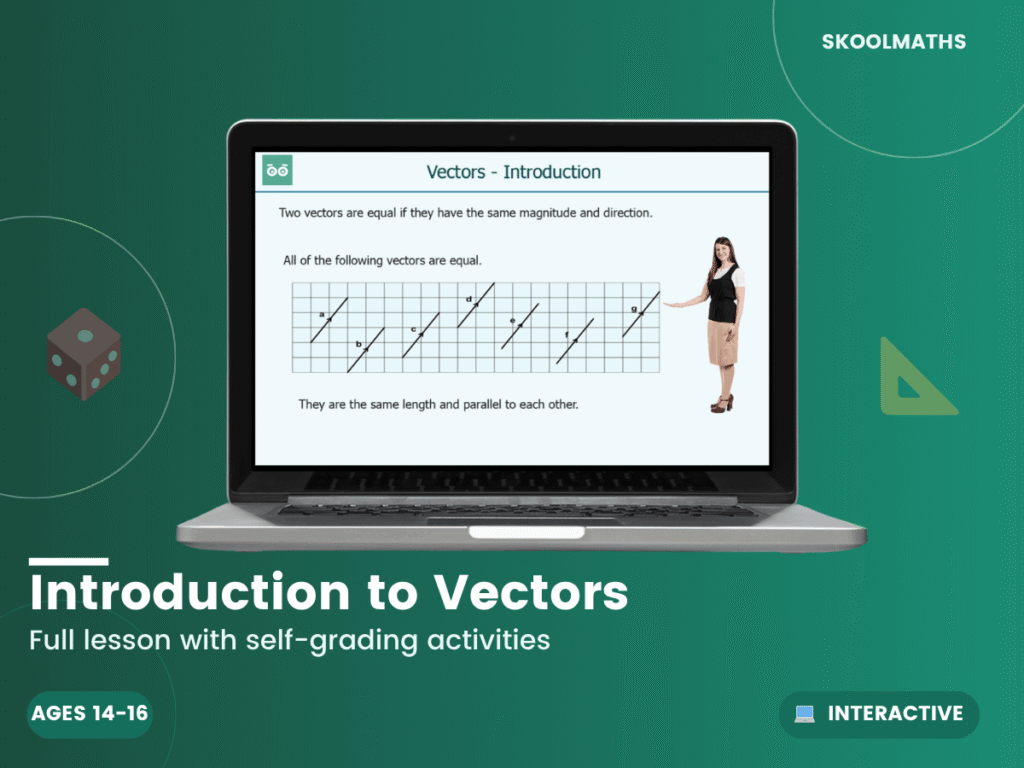
Introduction to Vectors — Interactive Lesson (Ages 14–16)

☆☆☆☆☆ Add your review • Year 10–11 • 🎓 Interactive Lesson & Activities
A 26-slide interactive KS4 lesson introducing vectors: magnitude and direction, column notation, magnitude by Pythagoras, unit vectors and i, j notation.

Included in every Skoolmaths plan

  • This resource plus every lesson, worksheet and game in its year group
  • Interactive lessons that mark answers and read aloud
  • New resources added every month
⭐ Get every resource with a Skoolmaths plan

or buy just this resource for £2.90

✅ Instant Access
💻 Any Device
🔒 Secure Checkout
♻️ Use Anytime

Lesson at a glance

What pupils will learn

  • Understand that a vector has both magnitude (size) and direction, unlike a scalar.
  • Recognise equal vectors.
  • Represent vectors using column vector and bold-letter notation.
  • Calculate the magnitude of a vector using Pythagoras' theorem.
  • Understand and calculate the negative of a vector.
  • Find the vector between two points from their coordinates.
  • Understand the zero vector and unit vectors.
  • Write vectors in terms of the unit base vectors i and j.

Curriculum

UK
Year 10–11 Maths, National Curriculum (England)
Topic area
Geometry and Measures
US equivalent
Grades 9–10 (year level only; not mapped to US standards)

What the lesson covers

  • What is a Vector? 🏹
  • Equal Vectors
  • Magnitude of a Vector 📏
  • Magnitude — Using Coordinates
  • Negative Vectors ➖
  • Vectors from Coordinates ✏️
  • Zero Vectors and Unit Vectors 0️⃣
  • Unit Base Vectors — Worked Example

How it is interactive

  • 7 multiple-choice questions
  • 5 fill-in-the-blank questions
  • 1 sorting and ordering task
  • 1 sentence-writing task

Feedback and what you get

Questions are marked automatically as pupils answer: a sound and a character reaction show straight away whether they are right, and correct answers earn points, with a results screen at the end. Sentence-writing tasks are for pupils' own answers and are not marked automatically.

A 26-slide interactive lesson that runs in any web browser on a computer, tablet or interactive whiteboard. Members open it online from their year group page. Buying it on its own gives you a .zip download to unzip and open.

Free preview: try the first slides before you decide. Included in every Skoolmaths plan.

What makes a vector different from a scalar? This 26-slide interactive introduction to vectors starts from the basics with magnitude and direction.

An Introduction to Vectors for Year 10–11 Maths

Students learn that a vector has both magnitude and direction, and how to write vectors in bold letters, as column vectors and as AB. They recognise equal vectors, find the magnitude using Pythagoras’ theorem, so that the vector (3, 5) has magnitude √34 = 5.83, and find negative vectors. They calculate a vector between two points, meet zero and unit vectors, and write a column vector using i and j.

What’s Included

  • 26-slide interactive introduction to vectors
  • Magnitude, direction, equal vectors and negative vectors
  • Column vector and bold-letter notation
  • Finding the magnitude with Pythagoras’ theorem
  • Quiz, fill-in-the-blank and sorting activities with instant feedback

Key Benefits for Students

  • Builds a clear picture of magnitude and direction
  • Links vectors to Pythagoras and coordinates
  • Introduces i and j notation early
  • Instant feedback on answer questions

Why Teachers Love It

  • No prep — ready for whole-class teaching on an interactive whiteboard
  • Worked examples model each notation clearly
  • Self-marking questions support independent practice
  • Includes an exam-style question on magnitude
  • A natural first lesson before vector arithmetic

Love this? You’ll love…

A dependable addition to a GCSE geometry topic, giving students a clear introduction to a topic that many find abstract. Secure notation here makes later vector proofs far more approachable.

Start vectors with confidence — Add to Basket.

FAQ

What year group is this for? Years 10–11 (ages 14–16), GCSE.

Does it cover column vectors? Yes — column vector and bold-letter notation are both covered.

Is it self-marking? Yes, with instant feedback on the questions.

Year Groups Year 10–11
Resource Type 🎓 Interactive Lesson & Activities
Format Digital Only
Curriculum England & Wales — KS4 (Years 10–11)
Added 4 March 2026

Reviews

There are no reviews yet.

Add your review

Your email address will not be published. Required fields are marked *

🎓 Get every resource for one low price

Membership unlocks this resource plus every lesson, worksheet and activity — all subjects, all year groups, all in one place.
View Membership Plans →

Free: our First Two Weeks Starter Pack

Eight print-and-go pages for a calm start with a new class, plus new lessons as we add them. About two emails a month.