One-time purchase. Instant digital download.
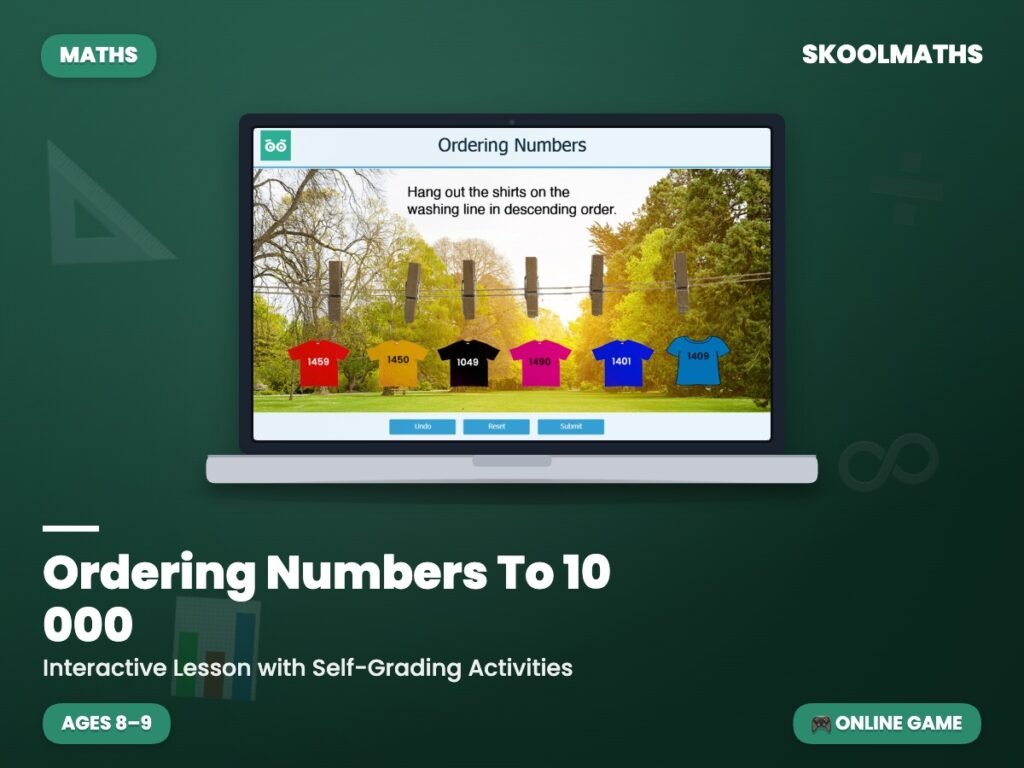
Who has the least savings, Michelle or Sarah? This 14-slide interactive lesson teaches ordering numbers to 10,000 using real-life scenarios pupils can picture.
Pupils learn to order a set of numbers up to 10,000, from smallest to greatest and greatest to smallest, using the language ‘ascending’ and ‘descending’. They hang shirts on a washing line in descending order, park cars in a car park with the smallest number first, and decide who has the least savings among four people with amounts such as £2,110 and £2,010. A final challenge compares a tree’s height in centimetres with how tall a giraffe would need to be to see over it.
A dependable addition to a Year 4 number topic, giving pupils confident, place-value-based ordering skills with numbers up to 10,000. This pairs naturally with comparing numbers, and both are needed for rounding and estimating later on.
Build confident ordering skills today — Add to Basket.
What year group is this for?
Year 4 (ages 8–9), KS2.
Does it use ascending and descending order?
Yes — both directions are practised.
Is it self-marking?
Yes, with instant feedback on the questions.
| Year Group | Year 4 Maths |
|---|---|
| Resource Type | 🎓 Interactive Lesson & Activities |
| Format | Digital Only |
| Curriculum | England & Wales — KS2 (Year 4) |
| Added | 4 March 2026 |
Membership unlocks this resource plus every lesson, worksheet and activity — all subjects, all year groups, all in one place.

Reviews
There are no reviews yet.