
Included in every Skoolmaths plan
Questions are marked automatically as pupils answer: a sound and a character reaction show straight away whether they are right, and correct answers earn points, with a results screen at the end.
A 21-slide interactive lesson that runs in any web browser on a computer, tablet or interactive whiteboard. Members open it online from their year group page. Buying it on its own gives you a .zip download to unzip and open.
Free preview: try the first slides before you decide. Included in every Skoolmaths plan.
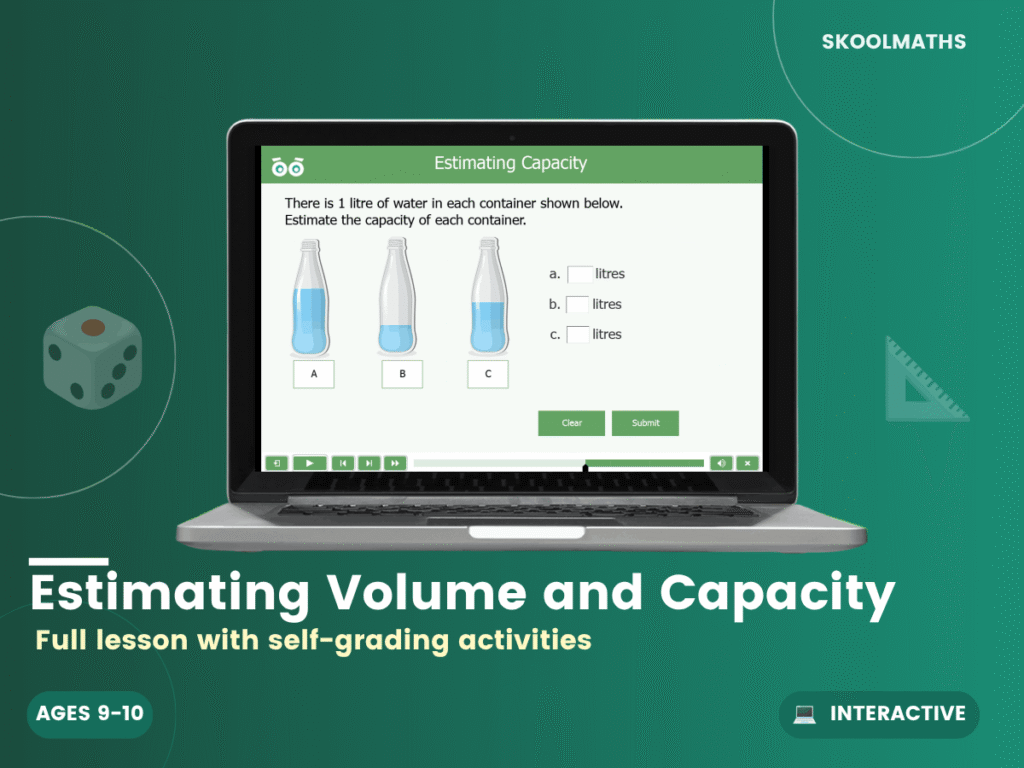
Would a kettle hold 200 ml or 1 litre? This 14-slide interactive lesson teaches estimating volume and capacity by choosing the most sensible estimate for everyday objects.
Pupils learn to understand the difference between capacity and volume, estimate capacity using practical equipment, and estimate the volume and capacity of different solids and objects. They select the most sensible capacity for a kettle, a bucket, a teacup and a large pot of rice, estimate the capacity of several containers holding 1 litre of water, and use the fact that 1 cubic centimetre of water weighs 1 gram to find the mass of a litre of water.
A dependable addition to a Year 5 measurement topic, giving pupils the practical number sense to judge whether a measurement is realistic. Estimating well here is what stops silly errors when converting and calculating capacity later.
Build confident estimating skills today — Add to Basket.
What year group is this for?
Year 5 (ages 9–10), KS2.
Does it link capacity to mass?
Yes — using the properties of water.
Is it self-marking?
Yes, with instant feedback on the questions.
| Year Group | Year 5 Maths |
|---|---|
| Resource Type | 🎓 Interactive Lesson & Activities |
| Format | Digital Only |
| Curriculum | England & Wales — KS2 (Year 5) |
| Added | 4 March 2026 |
Membership unlocks this resource plus every lesson, worksheet and activity — all subjects, all year groups, all in one place.
Free: our First Two Weeks Starter Pack
Eight print-and-go pages for a calm start with a new class, plus new lessons as we add them. About two emails a month.
Reviews
There are no reviews yet.