Skip to content

Parts of a Circle Year 6 Interactive Lesson

☆☆☆☆☆ Add your review Year 6 Maths 🎓 Interactive Lesson & Activities
Teach parts of a circle in Year 6 with a 30-slide interactive KS2 maths lesson covering radius, diameter and circumference, with self-marking activities.
$4.31

One-time purchase. Instant digital download.

🎓
Better value with membership Get unlimited access to this and every other resource across all subjects and year groups — for one low monthly price.
⭐ Get Unlimited Access — Members Only
Instant Access
💻 Any Device
🔒 Secure Checkout
♻️ Use Anytime

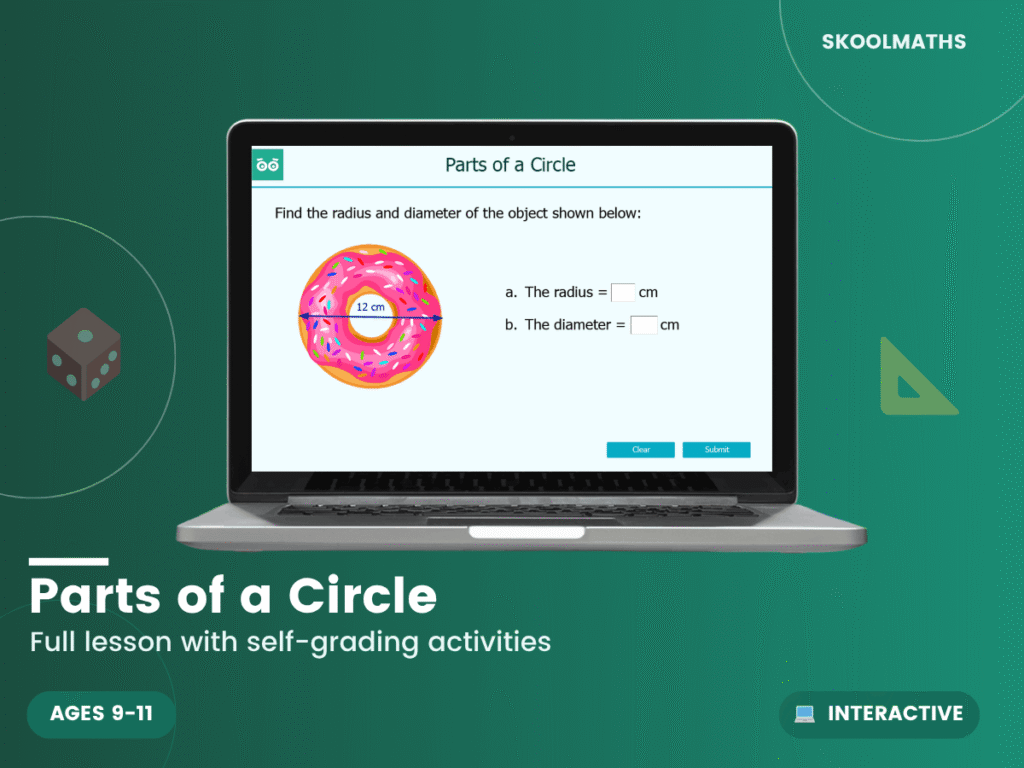
Teach parts of a circle in Year 6 with a ready-to-use, interactive KS2 maths lesson. Across 30 sequenced slides, pupils identify the radius, diameter and circumference, explore the relationship between radius and diameter, and apply their understanding to progressively more challenging problems.

With instant feedback and automatic marking built in, this digital resource is ideal for whole-class teaching, independent practice, revision, intervention and home learning.

What’s Included in parts of a circle Year 6?

  • 30 interactive teaching and activity slides
  • Clear explanations of centre, radius, diameter and circumference
  • Visual circle diagrams for identifying and labelling key parts
  • Drag-and-drop labelling activities
  • Multiple-choice, true-or-false and fill-in questions
  • Practice finding a diameter from a radius
  • Practice finding a radius from a diameter
  • Questions involving millimetres, centimetres and metres
  • Real-life problems involving coins, pizzas and circular objects
  • Fraction, measurement and unit-conversion challenges
  • Reasoning and multi-step problem-solving activities
  • Automatic scoring and instant answer feedback
  • End-of-lesson score, review and retry options

Description

This Year 6 circles lesson takes pupils from recognising the basic features of a circle to using the relationship between radius and diameter in calculations and reasoning problems.

Pupils begin by learning the meaning of centre, radius, diameter and circumference. They then identify these features on diagrams, complete mathematical statements and establish that the diameter is twice the radius.

Further activities develop fluency in using:

  • d=2×rd = 2 \times r
  • r=d÷2r = d \div 2

The lesson progresses to questions involving decimal measurements, unit conversions, fractions and everyday circular objects. More demanding reasoning problems help pupils explain relationships, select the correct operation and apply their understanding in unfamiliar contexts.

Because answers are checked automatically, pupils receive immediate feedback while teachers save valuable marking time.

Learning Objectives

By the end of the lesson, pupils should be able to:

  • name and identify the radius, diameter and circumference of a circle
  • understand the role of the centre of a circle
  • explain that the diameter passes through the centre
  • know that the diameter is twice the radius
  • calculate a diameter when the radius is known
  • calculate a radius when the diameter is known
  • use the relationship d=2rd = 2r when solving problems
  • apply their knowledge to reasoning and real-life measurement questions

National Curriculum Alignment

England National Curriculum for Mathematics

  • Key stage: Key Stage 2
  • Year group: Year 6
  • Domain: Geometry — properties of shapes
  • Common planning reference: 6G5

The statutory requirement states that pupils should:

“illustrate and name parts of circles, including radius, diameter and circumference and know that the diameter is twice the radius.”

The non-statutory guidance also suggests expressing the relationship algebraically, for example:

d=2×rd = 2 \times r

Curriculum Tie-In

National Curriculum requirementHow this lesson addresses it
Illustrate parts of circlesPupils examine, label and complete circle diagrams.
Name the radiusPupils identify radii and apply the definition to different diagrams.
Name the diameterPupils identify diameters and distinguish them from other lines.
Name the circumferencePupils learn that circumference means the distance around a circle.
Know that the diameter is twice the radiusPupils complete calculations, statements and true-or-false questions using this relationship.
Express the relationship mathematicallyActivities reinforce d=2rd = 2r and r=d÷2r = d \div 2.
Develop fluencyPupils complete repeated radius-and-diameter calculations with varied measurements.
Reason mathematicallyPupils assess claims, select formulas and explain circle relationships.
Solve problemsMulti-step questions use fractions, conversions, money and real-life circular objects.

Ideal For

  • Year 6 geometry lessons
  • KS2 circle revision
  • Whole-class interactive teaching
  • Independent computer or tablet work
  • Maths intervention groups
  • Early-finisher activities
  • Homework and home learning
  • Year 7 catch-up or transition work

Frequently Asked Questions

What are the parts of a circle in Year 6?

The statutory Year 6 vocabulary is radius, diameter and circumference. This lesson also uses the centre to help pupils understand and identify each part accurately.

Does this cover the Year 6 National Curriculum for circles?

Yes. It directly covers the Year 6 requirement to illustrate and name the radius, diameter and circumference and know that the diameter is twice the radius.

Is the diameter twice the radius?

Yes. The lesson teaches pupils that d=2rd = 2r and that the radius is half the diameter, r=d÷2r = d \div 2.

How do you teach radius and diameter in Year 6?

Begin with clear diagrams and definitions before asking pupils to identify each part. This lesson then introduces the radius–diameter relationship and develops it through calculations, unit conversions and reasoning problems.

Is this a Year 6 circles worksheet?

No. This is a digital interactive lesson, rather than a printable worksheet pack. Pupils complete the activities on screen and receive immediate feedback.

Is this printable, digital or both?

This resource is digital only. It is designed to run in a web browser and is best used on a computer, laptop or tablet.

Does it include an answer key?

Answers are built into the interactive lesson. Activities are marked automatically, and pupils can see feedback and review their responses. A separate printable answer-key document is not included.

Does this lesson calculate circumference using π?

No. In line with the Year 6 curriculum, pupils identify and name the circumference as the distance around a circle. Calculating circumference using π is later curriculum content.

What age group is this resource for?

It is designed for children aged 10–11 in UK Year 6. It may also support Year 7 catch-up, intervention or revision.

Can I use this for whole-class teaching?

Yes. Display it on an interactive whiteboard for whole-class instruction or allow pupils to complete it independently on computers or tablets.

Related Year 6 Maths geometry resources

Nets of 3D Shapes

Calculating Angles in Quadrilaterals

Year 6 Maths hub

Ready to Teach Parts of a Circle?

Save planning and marking time with a complete interactive lesson that moves pupils from circle vocabulary to confident radius-and-diameter problem solving.

Add the lesson to your basket for instant access, or choose Skoolmaths membership to unlock this and every other resource.

Designed for ages 10–11 (UK Year 6). Aligned to the UK National Curriculum; adaptable to US state standards.

Year GroupYear 6 Maths
Resource Type🎓 Interactive Lesson & Activities
FormatDigital Only
CurriculumEngland & Wales — KS2 (Years 3–6)
Added12 March 2020

Reviews

There are no reviews yet.

Add your review

Your email address will not be published. Required fields are marked *

🎓 Get every resource for one low price

Membership unlocks this resource plus every lesson, worksheet and activity — all subjects, all year groups, all in one place.

View Membership Plans →