
Skip to content

Addition Polymerisation — Interactive Lesson (Ages 14–16)

☆☆☆☆☆ Add your review • Year 10–11 • 🎓 Interactive Lesson & Activities
Pupils define monomer, polymer and repeating unit, explain why alkenes polymerise and name polymers from their monomers.

Included in every Skoolmaths plan

  • This resource plus every lesson, worksheet and game in its year group
  • Interactive lessons that mark answers and read aloud
  • New resources added every month
⭐ Get every resource with a Skoolmaths plan

or buy just this resource for $4.90

✅ Instant Access
💻 Any Device
🔒 Secure Checkout
♻️ Use Anytime

Lesson at a glance

What pupils will learn

  • Define monomer, polymer and repeating unit.
  • Explain why alkenes can form addition polymers.
  • Name a polymer from its monomer.
  • Work out the monomer from a repeating unit.
  • Link the properties of polymers to their uses.

Curriculum

UK
Year 10–11 Science, National Curriculum (England)
Topic area
Polymers and Natural Polymers
US equivalent
Grades 9–10 (year level only; not mapped to US standards)

What the lesson covers

  • Monomers and Polymers
  • How Addition Polymerisation Works
  • Naming Polymers
  • Properties and Uses

How it is interactive

  • 6 multiple-choice questions
  • 2 true or false questions
  • 1 fill-in-the-blank question
  • 1 sorting and ordering task
  • 1 sentence-writing task
  • 1 drag-the-words sentence
  • 1 reveal card

Feedback and what you get

Questions are marked automatically as pupils answer: a sound and a character reaction show straight away whether they are right, and correct answers earn points, with a results screen at the end. Sentence-writing tasks are for pupils' own answers and are not marked automatically.

A 20-slide interactive lesson that runs in any web browser on a computer, tablet or interactive whiteboard. Members open it online from their year group page. Buying it on its own gives you a .zip download to unzip and open.

Free preview: try the first slides before you decide. Included in every Skoolmaths plan.

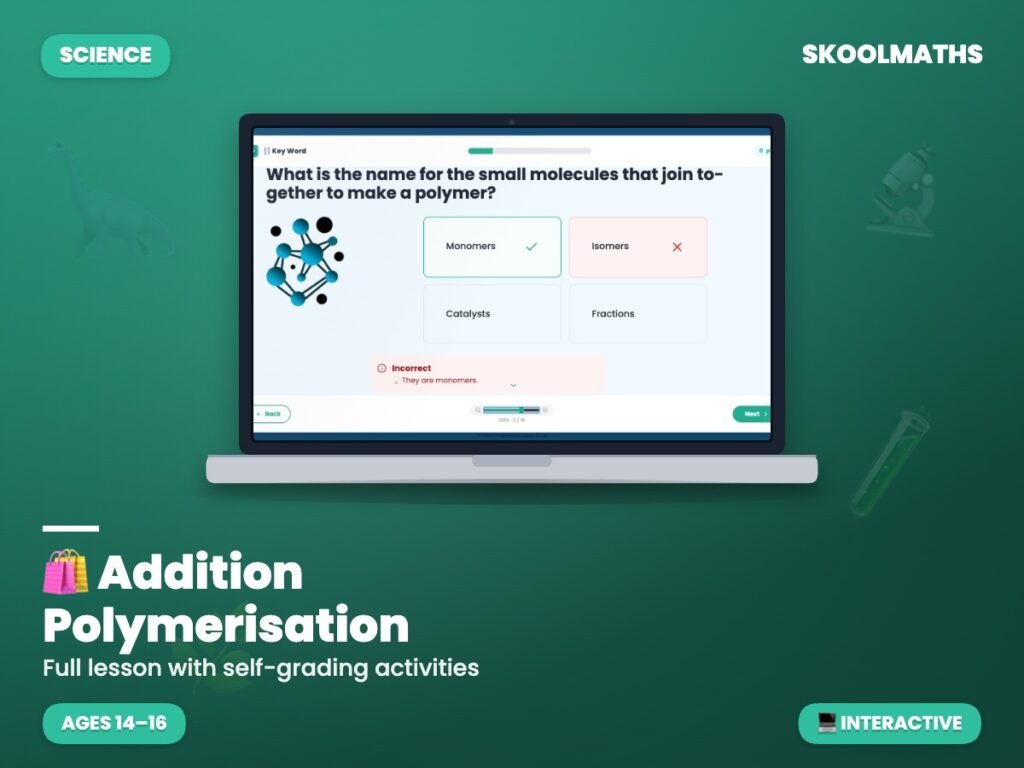
Thousands of small molecules linked into one giant chain — the chemistry of bags, pipes and non-stick pans. This 20-slide interactive lesson on addition polymerisation takes pupils from first ideas to exam-style explanations, with 12 self-marking activities and nothing to prepare beforehand.

Teaching Addition Polymerisation in GCSE Chemistry

Pupils define monomer, polymer and repeating unit, explain why alkenes polymerise and name polymers from their monomers. They work backwards from a repeating unit to the monomer and match poly(ethene), poly(propene), PVC, PTFE and polystyrene to their properties and everyday uses.

What Pupils Will Learn

  • Define monomer, polymer and repeating unit.
  • Explain why alkenes can form addition polymers.
  • Name a polymer from its monomer.
  • Work out the monomer from a repeating unit.
  • Link the properties of polymers to their uses.

What’s Included

  • 20-slide interactive lesson on addition polymerisation
  • 12 self-marking activities: multiple-choice questions, true-or-false checks, sorting tasks, drag-and-drop categorising and fill-in-the-gap questions
  • Step-by-step teaching cards that reveal one point at a time
  • A written explanation task with a model answer for self-assessment

Why Teachers Love It

  • No prep — open it on an interactive whiteboard, laptop or tablet
  • Instant feedback explains every answer, right or wrong
  • Examples from both Nigeria and the UK make the chemistry feel real
  • Works for whole-class teaching, independent study or revision

Curriculum Alignment

Supports the organic chemistry content of UK GCSE Chemistry (AQA, Edexcel and OCR) and the Nigerian Senior Secondary Chemistry curriculum (SS2–SS3), including WAEC and NECO exam preparation.

Love this? You’ll love…

Bring addition polymerisation to life today — Add to Basket.

FAQ

What year groups is this for? Years 10–11 (ages 14–16), and SS2–SS3 in Nigeria.

Is it self-marking? Yes — all 12 activities give instant feedback.

Do pupils need to log in? No. The lesson runs in any modern web browser.

Can I use it for revision? Yes. Pupils can replay it as often as they like, and the results screen shows which questions to review before a test.

Year GroupsYear 10–11
Resource Type🎓 Interactive Lesson & Activities
FormatDigital Only
CurriculumEngland & Wales — KS4 (Years 10–11)
Added23 October 2026

Reviews

There are no reviews yet.

Add your review

Your email address will not be published. Required fields are marked *

🎓 Get every resource for one low price

Membership unlocks this resource plus every lesson, worksheet and activity — all subjects, all year groups, all in one place.

View Membership Plans →