One-time purchase. Instant digital download.
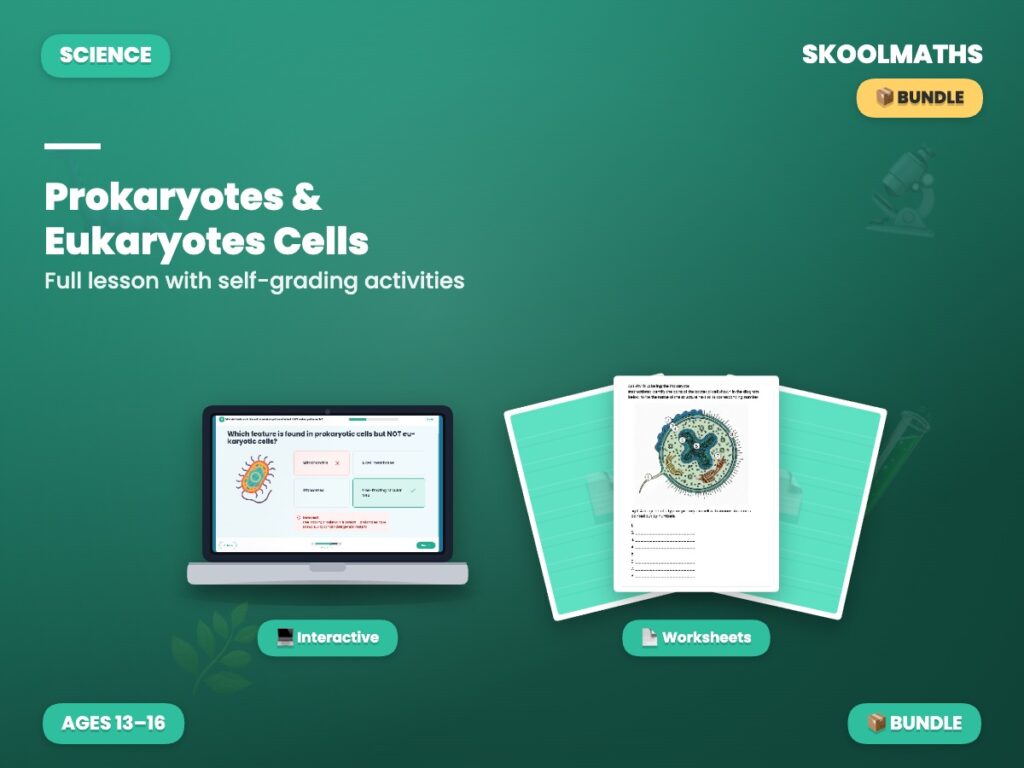
Do your students confuse prokaryotic and eukaryotic cells? This 20-slide interactive lesson compares the two cell types clearly, with a video slide, sorting activities and a printable worksheet.
Students learn that prokaryotic cells have no membrane-bound nucleus, with their DNA floating freely, and are always unicellular, while eukaryotic cells contain a true nucleus and can be unicellular or multicellular. They identify the key structures in each cell type, compare cell sizes (prokaryotes about 1–10 micrometres, eukaryotes about 10–100 micrometres) and explore the role of the nucleus.
A dependable addition to a cells topic, giving students a clear, well-structured comparison of the two main cell types. Secure understanding here underpins later work on cell organelles, microscopy and cell division.
Build confident cell biology today — Add to Basket.
What year group is this for? Years 9–11 (ages 13–16), KS3 and GCSE science.
Is a worksheet included? Yes — a 7-page printable worksheet with an answer key.
Does it include a video? Yes — the lesson includes a video slide.
| Year Groups | Year 9–11 |
|---|---|
| Resource Type | 📋 Lesson Pack |
| Format | Print & Digital |
| Curriculum | England & Wales — KS3–KS4 (Years 9–11) |
| Added | 4 August 2026 |
Verified reviews left by teachers who bought this resource on our TES and Teachers Pay Teachers stores.
This resource is as described- nice interactive slides to use w/ class on prokaryotic and eukaryotic cells. Due to the format it's not idea to send students to do on their own, but it's useful to use with a whole class.
Membership unlocks this resource plus every lesson, worksheet and activity — all subjects, all year groups, all in one place.

Reviews
There are no reviews yet.