One-time purchase. Instant digital download.
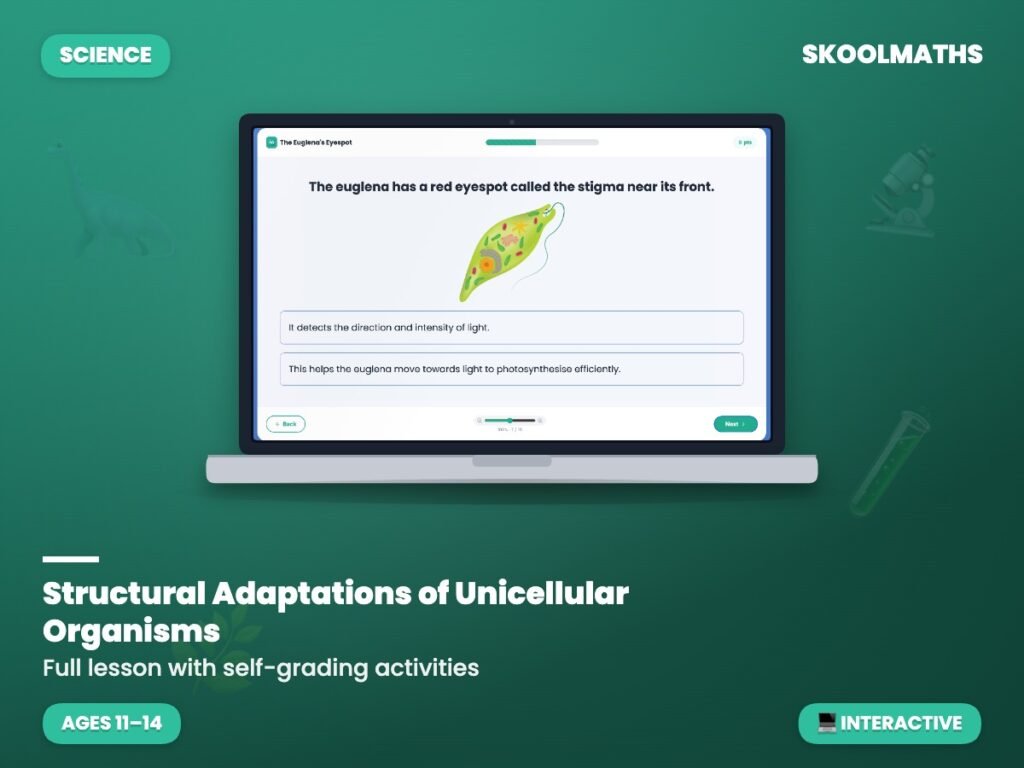
A single cell has to do everything a whole animal does — feed, move, breathe and reproduce — and that’s exactly why its shape matters so much. This structural adaptations of unicellular organisms lesson, built as an 18-slide interactive lesson, gives KS3 students a close look at how amoeba, euglena and paramecium are built to survive.
Students explore real structural adaptations — the amoeba’s pseudopodia for feeding and movement, the euglena’s flagellum and light-detecting eyespot, and the paramecium’s cilia and contractile vacuole — with instant self-marking feedback throughout.
This resource covers the KS3 National Curriculum area of cell biology, exploring how unicellular organisms are structurally adapted to carry out every life process within a single cell.
Structural adaptations of unicellular organisms explain how microbes survive in ponds, soil and even the human gut — the same principle scientists use when studying how bacteria adapt to antibiotics.
| Year Groups | Year 7–9 |
|---|---|
| Resource Type | 🎓 Interactive Lesson & Activities |
| Format | Digital Only |
| Curriculum | England & Wales — KS3 (Years 7–9) |
| Added | 8 September 2026 |
Membership unlocks this resource plus every lesson, worksheet and activity — all subjects, all year groups, all in one place.



Reviews
There are no reviews yet.