19 curriculum-aligned multiplication and divisions resources for Year 2 Maths — worksheets and digital lessons, or unlock everything with a membership.
Membership unlocks every lesson, worksheet and activity — for every subject and year group.
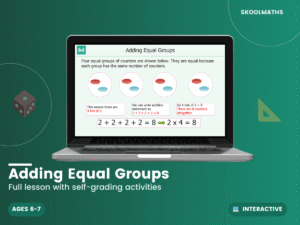
Year 2 is where multiplication and division are introduced properly, through the 2, 5 and 10 times tables, arrays, and the idea that multiplication can be done in either order.
By the end of Year 2, the National Curriculum expects pupils to:
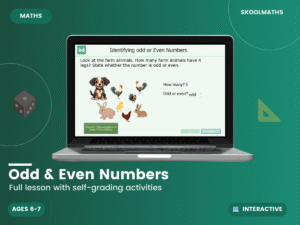
multiply, times, array, equal groups, divide, share, group, odd, even, commutative, repeated addition
Year 2 is pupils’ first formal multiplication and division, building on counting in 2s, 5s and 10s from Year 1. In Year 3, pupils add the 3, 4 and 8 times tables and begin multiplying two-digit numbers.
What is an array?
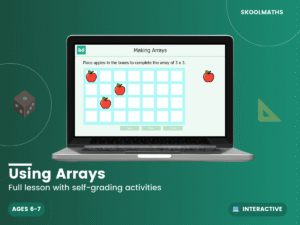
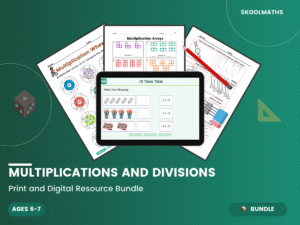
Objects arranged in equal rows and columns, used to show multiplication visually. 3 rows of 4 counters shows 3 × 4 = 12, and turning the array on its side shows 4 × 3 = 12 too.
Why does order matter for division but not multiplication?
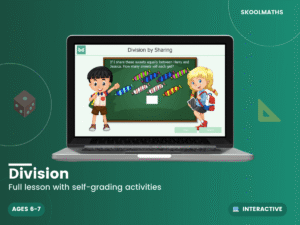
3 × 5 and 5 × 3 both equal 15, but 15 ÷ 3 and 3 ÷ 15 give very different answers, so division must be tackled in the order it’s written.
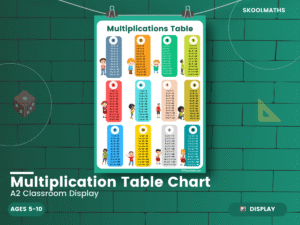
How can I help my child learn the 2, 5 and 10 times tables?
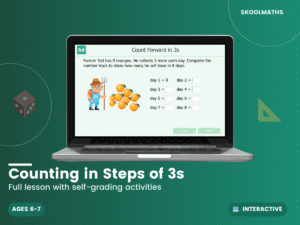
Counting aloud in steps of 2, 5 and 10, forwards and backwards, builds the pattern before the multiplication facts are drilled on their own.
Start with our free resources, or get every Year 2 maths lesson with a membership.