7 curriculum-aligned forces and magnets resources for Year 3 Science — worksheets and digital lessons, or unlock everything with a membership.
Membership unlocks every lesson, worksheet and activity — for every subject and year group.
In Year 3, pupils investigate how things move on different surfaces and discover that magnets are a force that works without touching.
By the end of Year 3, the National Curriculum expects pupils to:
force, push, pull, surface, friction, magnet, magnetic, non-magnetic, attract, repel, north pole, south pole, contact force
Year 3 builds on pushes, pulls and changing shapes from Key Stage 1. In Year 5, pupils study gravity, air resistance, water resistance and friction, and how levers, pulleys and gears let a small force have a bigger effect.
Are all metals magnetic?
No. Iron, steel, nickel and cobalt are attracted to magnets, but many common metals, such as aluminium, copper, brass and gold, are not. A drinks can test is a great surprise for many children.
When do magnets attract and when do they repel?
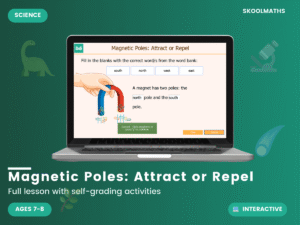
Opposite poles (north and south) attract. Like poles (north and north, or south and south) repel, pushing each other apart.
Why do things move differently on different surfaces?
Rough surfaces create more friction than smooth ones, so a toy car slows down faster on carpet than on a smooth floor.
Start with our free resources, or get every Year 3 science lesson with a membership.