6 curriculum-aligned earth and space resources for Year 5 Science — worksheets and digital lessons, or unlock everything with a membership.
Membership unlocks every lesson, worksheet and activity — for every subject and year group.
Earth and space is studied in Year 5. Pupils learn how the Earth, the Moon and the planets move, and use the Earth’s rotation to explain day and night.
By the end of Year 5, the National Curriculum expects pupils to:
Sun, star, Earth, Moon, planet, solar system, orbit, rotate, axis, spherical, day, night, year, Mercury, Venus, Mars, Jupiter, Saturn, Uranus, Neptune
Year 5 builds on Year 3’s work on light and shadows. At Key Stage 3, pupils go further with gravity, the seasons, and the Earth’s place in the galaxy and the universe.
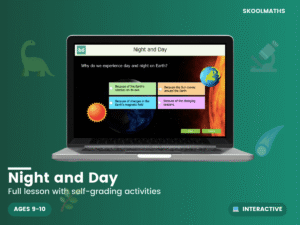
Why do we have day and night?
The Earth spins on its axis once every 24 hours. The half facing the Sun has day, and the half facing away has night.
Does the Sun move across the sky?
It looks that way, but it’s the Earth that is turning. As the Earth rotates, the Sun appears to rise in the east and set in the west.
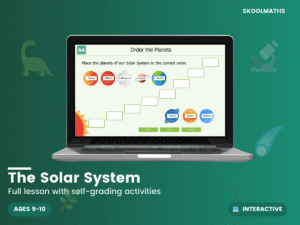
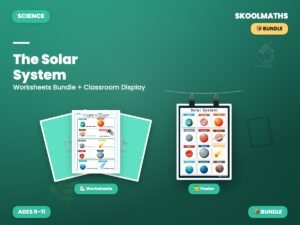
How many planets are in our solar system?
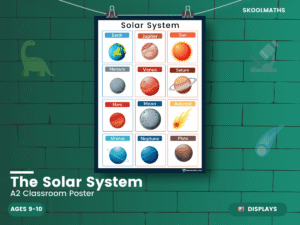
Eight: Mercury, Venus, Earth, Mars, Jupiter, Saturn, Uranus and Neptune. A popular way to remember the order is “My Very Easy Method Just Speeds Up Naming”.
Start with our free resources, or get every Year 5 science lesson with a membership.