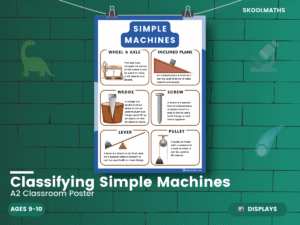
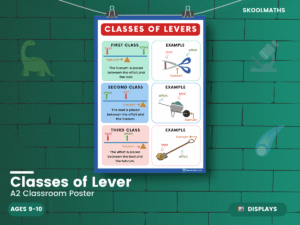
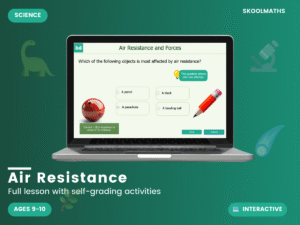
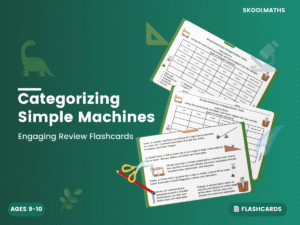
8 curriculum-aligned forces resources for Year 5 Science — worksheets and digital lessons, or unlock everything with a membership.


Membership unlocks every lesson, worksheet and activity — for every subject and year group.
Year 5 returns to forces with new, more abstract ideas: gravity, air resistance, water resistance and friction, and the simple machines that make a smaller force do a bigger job.
By the end of Year 5, the National Curriculum expects pupils to:
gravity, Earth, air resistance, water resistance, friction, mechanism, lever, pulley, gear, upthrust
Year 5 builds on Year 3’s forces and magnets, where pupils first met the idea of a push or pull. At secondary school, pupils go on to measure forces in newtons and calculate speed, distance and time.
Why do a feather and a hammer fall at different speeds?
Gravity pulls them down at the same rate, but air resistance pushes back much more on the feather’s large surface area, slowing it down more than the hammer.
What is friction, and is it ever useful?
Friction is a force that resists movement between two surfaces in contact. It can slow things down unhelpfully, but it is also essential: it is what lets shoes grip the floor and brakes stop a bicycle.
How does a pulley make lifting easier?
A pulley changes the direction of a force, or spreads the load across more rope, so a person can lift a heavy object using less force than lifting it straight up by hand.
Start with our free resources, or get every Year 5 science lesson with a membership.