7 curriculum-aligned living things and their habitats resources for Year 6 Science — worksheets and digital lessons, or unlock everything with a membership.
Membership unlocks every lesson, worksheet and activity — for every subject and year group.
Year 6 brings classification to living things: grouping plants and animals by what they have in common, the way scientists do, rather than just by habitat or appearance.
By the end of Year 6, the National Curriculum expects pupils to:
classify, classification, characteristic, vertebrate, invertebrate, micro-organism, broad group, species
Year 6 draws on habitats and food chains from Year 4, and animal groups from Year 4 and 5. At secondary school, pupils extend classification into kingdoms and the full biological classification system.
What is the difference between a vertebrate and an invertebrate?
Vertebrates have a backbone (fish, amphibians, reptiles, birds and mammals); invertebrates do not (insects, spiders, worms and snails).
Why do scientists classify living things?
Grouping by shared characteristics makes it easier to study, compare and talk about the huge variety of life, and to spot how different groups are related to each other.
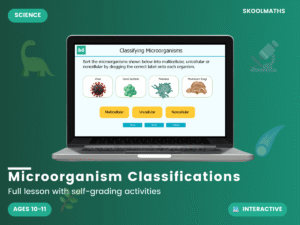
What counts as a micro-organism?
A living thing too small to see without a microscope, such as bacteria and some fungi. Pupils learn that micro-organisms can be helpful, like yeast in bread, or harmful, like those that cause illness.
Start with our free resources, or get every Year 6 science lesson with a membership.