Skip to content

Probability of Mutually Exclusive Events — Interactive Lesson & Worksheet (Ages 14–16)

☆☆☆☆☆ Add your review • Year 10–11 • 📋 Lesson Pack
An 18-slide interactive KS4 lesson on mutually exclusive events and the addition law, with worked examples and a printable worksheet with answers.
$5.01

One-time purchase. Instant digital download.

🎓
Better value with membership Get unlimited access to this and every other resource across all subjects and year groups — for one low monthly price.
⭐ Get Unlimited Access — Members Only
✅ Instant Download
🖨️ Print & Digital
🔒 Secure Checkout
♻️ Unlimited Use

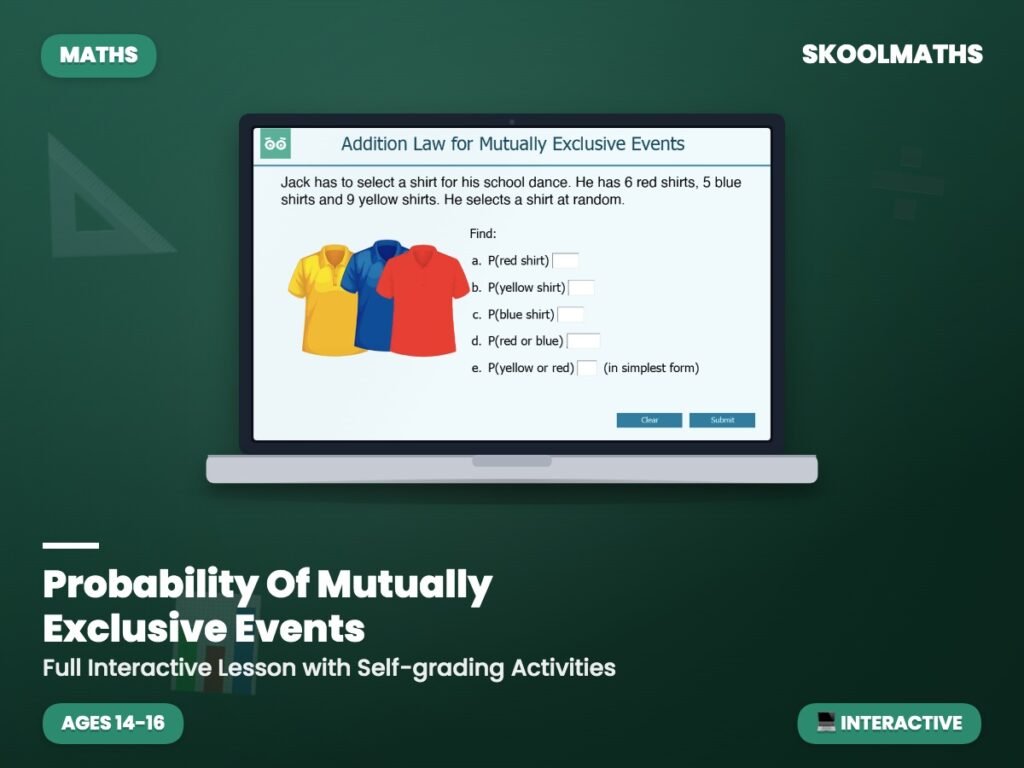
Can these two events happen at the same time? This 18-slide interactive lesson teaches mutually exclusive events and the addition law, one clear step at a time.

Understanding Mutually Exclusive Events at GCSE

Students learn that two events are mutually exclusive when they cannot happen at the same time, so the probabilities can be added: P(A or B) = P(A) + P(B). Worked examples include a coin landing on heads or tails, cards showing a square or a triangle, and a team winning or drawing. They also learn that the probabilities of an exhaustive set of mutually exclusive events add up to 1, so if the chance of rain is 0.92 the chance of no rain is 0.08.

What’s Included

  • 18-slide interactive lesson on mutually exclusive events
  • Learning objectives on mutually exclusive events, probabilities adding to 1 and the addition law
  • A starter on finding the probability of an event not happening
  • Worked examples with coins, cards and match results
  • A printable worksheet with two question pages and an answer page

Key Benefits for Students

  • Makes it clear when probabilities can be added
  • Links the addition law to probabilities summing to 1
  • Shows which events are and are not mutually exclusive
  • Instant feedback on answer questions

Why Teachers Love It

  • No prep — ready for whole-class teaching on an interactive whiteboard
  • The worksheet gives ready-made practice with answers
  • Self-marking questions support independent practice
  • Suits teaching, revision and homework
  • Familiar contexts keep examples accessible

Love this? You’ll love…

A dependable addition to a GCSE probability topic, giving students a clear rule for combining events. Confidence here leads naturally into independent events and conditional probability.

Build confident probability skills today — Add to Basket.

FAQ

What year group is this for? Years 10–11 (ages 14–16), GCSE.

Is a worksheet included? Yes — two question pages and an answer page.

Do the probabilities of exclusive events add up to 1? Yes, for an exhaustive set — the lesson explains why.

Year Groups Year 10–11
Resource Type 📋 Lesson Pack
Format Print & Digital
Curriculum England & Wales — KS4 (Years 10–11)
Added 4 March 2026

Reviews

There are no reviews yet.

Add your review

Your email address will not be published. Required fields are marked *

🎓 Get every resource for one low price

Membership unlocks this resource plus every lesson, worksheet and activity — all subjects, all year groups, all in one place.
View Membership Plans →