One-time purchase. Instant digital download.
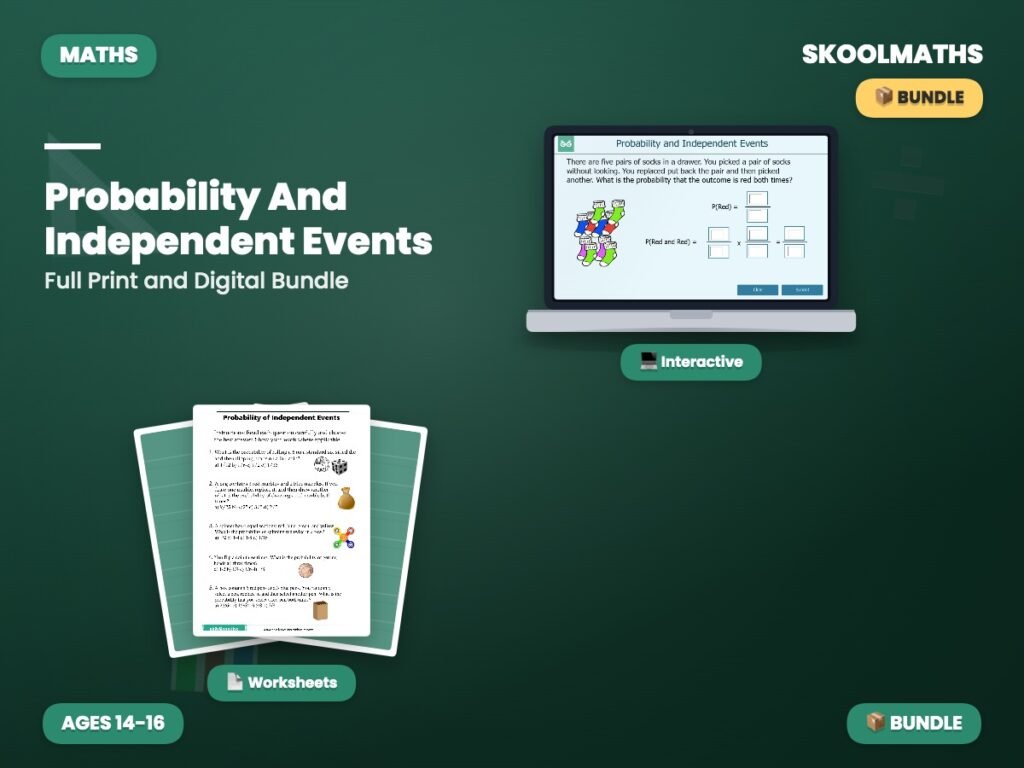
Not sure when to multiply probabilities? This 22-slide interactive lesson explains independent events and shows students how to find the probability of two or more events happening together.
Students learn that events are independent when the outcome of one does not affect the other, and that the probability of two independent events is found by multiplying, so P(A and B) = P(A) × P(B). The method extends to three or more events. Worked examples include tossing two coins, rolling a dice twice, spinning a three-coloured spinner twice and rolling a dice while spinning a coin.
A dependable addition to a GCSE probability topic, giving students a secure method for combined events. Confidence with independent events here leads naturally into conditional probability and tree diagrams.
Build confident probability skills today — Add to Basket.
What year group is this for? Years 10–11 (ages 14–16), GCSE.
Is a worksheet included? Yes — a 2-page printable worksheet with an answer page.
Does it cover more than two events? Yes — the multiplication rule is extended to three or more events.
| Year Groups | Year 10–11 |
|---|---|
| Resource Type | 📋 Lesson Pack |
| Format | Print & Digital |
| Curriculum | England & Wales — KS4 (Years 10–11) |
| Added | 4 March 2026 |
Membership unlocks this resource plus every lesson, worksheet and activity — all subjects, all year groups, all in one place.

Reviews
There are no reviews yet.