One-time purchase. Instant digital download.
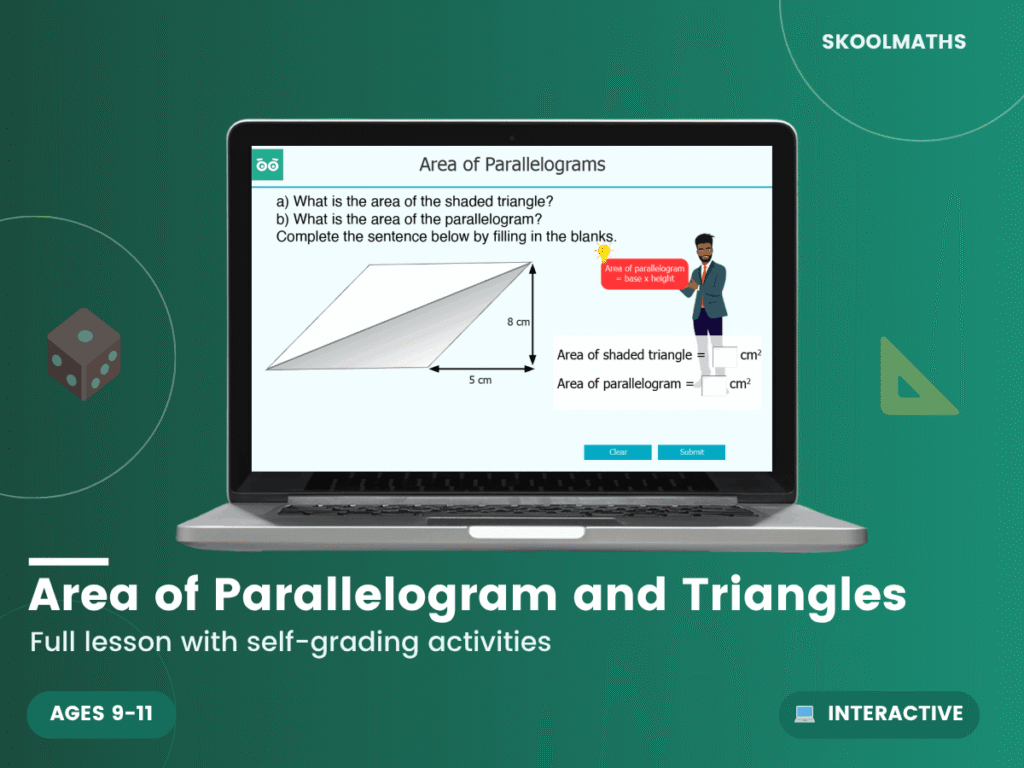
Why is a triangle’s area half the base times height? This 38-slide interactive lesson builds the area of triangles and parallelograms from a rectangle pupils already know.
Pupils use their previous knowledge of finding the area of a rectangle to find the area of a right-angled triangle, then extend this to any triangle, before using the same idea for a parallelogram. They see that a rectangle contains two triangles, so the area of a triangle is base × height ÷ 2, or ½BH, and that any side can be used as the base once the height is measured from the opposite vertex. For a parallelogram, they learn area = base × height, for example a base of 12 cm and height of 6 cm giving 72 cm².
A dependable addition to a Year 6 geometry topic, giving pupils a secure link between the shapes they already know and new area formulae. Confidence here supports circles, compound shapes and volume at secondary school.
Build confident area skills today — Add to Basket.
What year group is this for?
Year 6 (ages 10–11), KS2.
Does it cover parallelograms as well as triangles?
Yes — both shapes are covered.
Is it self-marking?
Yes, with instant feedback on the questions.
| Year Group | Year 6 Maths |
|---|---|
| Resource Type | 🎓 Interactive Lesson & Activities |
| Format | Digital Only |
| Curriculum | England & Wales — KS2 (Year 6) |
| Added | 22 April 2019 |
Membership unlocks this resource plus every lesson, worksheet and activity — all subjects, all year groups, all in one place.




Reviews
There are no reviews yet.