
Pupils explain why atoms bond, then compare ionic bonding (electron transfer between metals and non-metals), covalent bonding (shared pairs of electrons) and metallic bonding (positive ions in a sea of delocalised electrons).
Included in every Skoolmaths plan
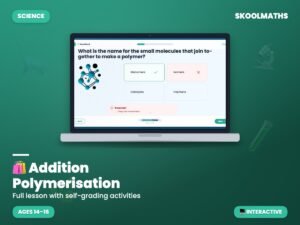
Questions are marked automatically as pupils answer: a sound and a character reaction show straight away whether they are right, and correct answers earn points, with a results screen at the end. Sentence-writing tasks are for pupils' own answers and are not marked automatically.
A 21-slide interactive lesson that runs in any web browser on a computer, tablet or interactive whiteboard. Members open it online from their year group page. Buying it on its own gives you a .zip download to unzip and open.
Free preview: try the first slides before you decide. Included in every Skoolmaths plan.
Why is salt hard to melt, water easy to boil and copper perfect for wires? It's all in the bonding. This 21-slide interactive lesson on ionic bonding takes pupils from first ideas to exam-style explanations, with 13 self-marking activities and nothing to prepare beforehand.
Pupils explain why atoms bond, then compare ionic bonding (electron transfer between metals and non-metals), covalent bonding (shared pairs of electrons) and metallic bonding (positive ions in a sea of delocalised electrons). They work out ion charges, link structure to melting point and conductivity, explain why graphite conducts but diamond does not, and explain why alloys are harder than pure metals.
Supports UK GCSE Chemistry and Combined Science (AQA, Edexcel and OCR) and the Nigerian Senior Secondary Chemistry curriculum (SS1), including WAEC and NECO exam preparation.
Bring ionic bonding to life today — Add to Basket.
What year groups is this for? Years 10–11 (ages 14–16), and SS1 in Nigeria.
Is it self-marking? Yes — all 13 activities give instant feedback.
Do pupils need to log in? No. The lesson runs in any modern web browser.
Can I use it for revision? Yes. Pupils can replay it as often as they like, and the results screen shows which questions to review before a test.
| Year Groups | Year 10–11 |
|---|---|
| Resource Type | 🎓 Interactive Lesson & Activities |
| Format | Digital Only |
| Curriculum | England & Wales — KS4 (Years 10–11) |
| Added | 23 October 2026 |
Membership unlocks this resource plus every lesson, worksheet and activity — all subjects, all year groups, all in one place.
Reviews
There are no reviews yet.